Sunday, March 5, 2017

A Rich Past for a Positive Future for Theology


with Professor John Cobb
As an Asian postcolonial feminist theologian, my relationship to the Christian past is multifaceted and ambivalent. My reading of the Bible and the long theological tradition is never a “natural” reading, arising out of a living tradition that shaped my culture. For example, I wondered how the terms ousia and hypostases in the debates on Trinity could be translated into Chinese and whether there would be equivalent concepts in Chinese philosophy. 

So why do we have to study the Christian past? Sometimes my students put this even more bluntly, “Why do we have to study the dead white guys?” 

We study the past because we want to learn different models of how theologians addressed social, political, and ecclesiastical issues of their time. Take for instance, this year we are commemorating the 500th anniversary of Luther’s posting of the 95 theses. The questions that Luther, Calvin, Zwingli, and Münster raised for the church and wider public remain with us to this day, such as, the source of authority, the shape of liturgy and the meaning of sacraments, the visible and invisible church, the relation between the two kingdoms, and the relation between the established church and radical reform impulses.  

A highly relevant question for today might be “How can the Church be reformed so that it might respond to the challenges of the Trump era?” Although the Chinese may not have an event equivalent to the Reformation, the Reformation provided a mirror through which to look at the relation between religion, politics, and power at a watershed moment of the early development of capitalism and modernity. 

Without learning from the past, we impoverish ourselves because we are left with the tyranny of the present. We can easily lose hope and fall prey to cynicism and despair. This is especially important in the United States because historical literacy is low and people seek immediate relevance. Facebook and social media outlets can make us obsessed with the immediate present. Learning from history allows us to maintain a certain distance and to have a broader perspective when examining our present time. 

Given that we have such a long and rich theological tradition and so many theological giants before us, there is also the danger of the tyranny of the past. We might become so immersed and inculturated into certain modes of theological thinking, patterns of argument, and the common vocabularies of a certain theological tradition and our minds be so colonized that we are unable to see the horizon beyond or dare to take the road less traveled. 

Theological innovations often begin by posting radical questions to the past. The feminist theological movement wrestled with the validity of past tradition. Mary Daly argued that the Christian tradition is so sexist that it is irredeemable, while Letty Russell spoke of a usable past. Elisabeth Schüssler Fiorenza offered a revisionist history of Christian origin, and Rosemary Radford Ruether recovered the lost voices of Christian women in history. 

Many theologians who have found their cultures and traditions left out from the dominant theological tradition have recovered their histories through the use of slave narratives, alternative archives, oral history, literature, and myths and stories to create a colorful tapestry of theologies. Today, theology is a global enterprise and we must pay attention to the global contexts shaping human lives and our theological imagination. Theology is contextual, but our contexts are deeply intertwined today. We need to find ways to educate ourselves about how others are developing theologies to respond to common concerns of our time. This must be a sustained and deliberate effort and not something to do only when we have time. 

I wish I knew when I began to study theology that this would be a life-long vocation with many twists and no easy answers. Our work is harder because, unlike Luther and the reformers who stood in the vanguard of the intellectuals of their time, we as contemporary theologians have to defend our existence in the academy and larger society. When Christian theology is in a defensive posture, the marginal voices within it could be even more marginalized or suppressed. A danger for theological movements is that they become reactionary or ossified over time and fail to respond to new challenges. There is often much excitement when a theological movement begins, but as it becomes institutionalized or domesticated, it needs new reformers and discussants to keep it alive and on the cutting-edge.  

Facing the future, theologians have important roles to play in the Trump era. Latin American theologians reminded us that we must distinguish between the worship of God and the worship of idols. When people are mesmerized by populist claims such as “Make America Great Again” and the representation of the President as pseudo-Messiah, theologians must challenge idolatry and alternative facts. In the battle for truth, we stand on the shoulders of giants such as Dorothy Day, Martin Luther King, Jr., Dietrich Bonhoeffer, Y. T. Wu, Oscar Romero, Mercy Oduyoye, Tissa Balasuriya, Desmond Tutu, Gustavo Gutiérrez, Ivone Gebara, and others. When the country begins to look inward, we need theologians and leaders of faith communities who are cosmopolitan in theological outlook, astute about world politics, and have a deep sense of American multiracial and multicultural history.  

We must develop a culture of resistance in the churches and rid ourselves of Constantinian Christianity in order to see clearly the life and ministry of a postcolonial Jesus. Americans have not been comfortable seeing the connections between empire and Christianity. Middle-class American Christianity has so successfully adapted to the individualistic culture that religion has often become a private affair.  

The Christian message of sin, atonement, justification, and salvation has been thoroughly individualized, if not psychologized, such that they have relatively little social import. We look at Jesus as primarily a religious figure, separated from the highly politicized and volatile situation of his time, an era filled with periodic popular revolts and protests against Roman colonial rule. We must recover that the Jesus movement was a resistance movement against Pax Romana. Jesus was not a passive religious leader, but took an uncompromising stance against the Roman Empire and its client Judean and Galilean rulers. Jesus’ revolutionary message is relevant to our time more than ever as we struggle against pax Americana. 

Do I think theology will have a positive future? My answer is yes. When I began to study theology in the early 1970s, Gustavo Gutierrez has published A Theology for Liberation Theology for a few years. Mary Daly has not published Beyond God the Father. As a doctoral student, I witnessed the development of Womanist theology, Mujerista and Latina theology, Asian American feminist theology, and gay and lesbian theology. Today we have such a plurality of voices arising from racial and ethnic communities in the U.S. and from faith communities around the world.

In the 1960s, some of the avant garde theologians launched a series of books with the title “New Frontiers in Theology” and their aim was to facilitate “discussions among Continental and American theologians” and the discussants were all male. Here at this conference, we have such diversity of theological voices, and this should give us hope for a positive and more inclusive future. 

(Presented at the “New Frontiers in Theology” Conference at Claremont School of Theology on February 17, 2017)

Tuesday, February 25, 2014

Feminist Professors Are Not Secluded Monks


In his column “Professors, We Need You!” New York Times columnist Nicholas Kristof charges that most university professors “just don’t matter in today’s great debates” and admonishes them not to cloister themselves “like medieval monks.”

Many academics and others took offense at what he has written. A Twitter hashtag

#engagedacademics sprung up and many have posted opposing views.


That Kristof imagines the professors who isolate themselves from the real world as “medieval monks” betrays his bias that the professors to whom he is addressing and the public intellectuals he longs to see are male (and possibly white)!

Kristof is an award-winning columnist who has written on sexual violence against women globally, human rights issues, and Chinese politics. Yet, he has overlooked that feminist professors have engaged in political struggles for decades and many have used Twitter and other social media to spread our ideas and further our causes.

Gwendolyn Beetham, an adjunct professor of Women’s and Gender Studies at Brooklyn College, responds that Kristof has failed to take women and marginalizedgroups’ concern about public engagement seriously. Women’s voices are routinely neglected and those who dare to enter public debates are shunned or even threatened. Professor Brittney Cooper, an African American scholar, was physically threatened while speaking in a forum in New York and British classicist Mary Beard was threatened with rape and having her home bombed via Twitter.

The mainstream media marginalizes scholars in the field of feminism and religion. In debates such as the provision of contraceptives in health insurance, the future of the Catholic Church under Pope Francis, and gender violence associated with religion, we seldom hear the voices of feminist intellectuals in the mass media. Male scholars, conservative TV and radio hosts, and religious leaders have the large microphones.

Kristof has overlooked that many professors in religion who are women of color are closely related to their communities and have worked tirelessly to effect social change. The late Mujerista theologian Ada María Isasi-Díaz is one shining example. She was very involved in the Women’s Ordination movement in the Catholic Church and she interviewed grassroots Latinas and included their voices in her ethical analysis. A new group “Women of Color Scholarship, Teaching, and Activism” has been formed at the American Academy of Religion to discuss challenges to women of color who want to be engaged scholars.

Many have pointed out that Kristof has only looked at publications such as the New York Times or the New Yorker when he laments the diminishing presence of public intellectuals. Had he looked wider, he might has noticed that feminist scholars, including those in religion, are actively blogging, tweeting, uploading pictures and videos in Instagram and Google Plus, and using other forms of social media. We have written op-eds and blogged on Huffington Post, Feminism and Religion, Feminist Studies in Religion, Religion Dispatches, Patheos, Center for American Progress, and other websites. Some of us post videos or appear in YouTube and have personal blogs. I have started a blog several years ago to share my ideas about postcolonialism and religion and to connect with my readers.

Kristof notes the pressure on academics to publish peer-reviewed articles and books. But he does not mention the underclass of adjuncts who earn $2,000 to $3,000 per class and can hardly make ends meet. According to the Coalition on Academic Workforce, adjuncts earn on average $21,600, while tenure-track positions averaged $66,000 a year. Some labor groups estimate that adjunct faculty make up to 75 percent of higher education positions. Women make up 61 percent ofadjunct faculty, according to the Coalition.

The scarcity of jobs in the field of religion and the growing use of adjuncts have made many feminist professors wonder whether they should encourage their bright female students to pursue a PhD. Some are concerned whether to encourage their PhD students to do research in feminism and religion, for fear that this will further narrow their marketability. Several trade presses in religion are publishing mostly textbooks and there are fewer venues for feminist religious scholarship.

I am convinced that the world needs feminist work in religion more than ever. The generation of feminist scholars in religion before us faced ridicule, censorship, and loss of employment when they charted a new territory and started a new field. They have laid a solid foundation for us to build on. It is important for us to discuss how the field will flourish and how feminist professors can continue their work as engaged intellectuals and help the upcoming generation.  
 
This article is cross-posted on Feminism and Religion.

Sunday, January 26, 2014

Acu-yoga: Synergy of Shiatsu, Acupuncture, and Yoga


Yoga postures can activate energy centers of the body called chakras. Shiatsu and acupuncture can revitalize the body and clear blockages through activating particular points along the meridians on the body.

While traveling as a college student, I learned shiatsu, an ancient form of bodywork, from a Japanese friend. I practice yoga and have used acupuncture to relieve body pain. So when I heard about a workshop called Acu-yoga led by a yoga teacher and a shiatsu practitioner and acupuncturist, I was excited to learn more about how these ancient systems intersect.

This afternoon I attended the Acu-yoga workshop at a yoga studio at Boston’s famous Newbury Street. About two dozen people, mostly young women and men, paid the $45 fee to attend this special workshop. It was cold outside, with temperature around 18 degrees Fahrenheit.

Karma, the yoga teacher, began the workshop with gentle breathing exercises. She especially asked us to breathe into the belly and the back where the kidneys are located. Karma has long blond hair, a slim body, and a gentle voice, which is very soothing.

After several minutes of breathing, Zoe, who practices shiatsu and acupuncture, explained the location of the Bladder meridian. She asked us to form a fist and use the knuckle on the thumb to press on the space between the eyebrows. From there, we would use the knuckle to lightly knock along the meridian up the center of the forehead, across the head, and reaching down the back of the head to the sides of the spinal column. She said the meridian continues along the bottom to the back of the legs and all the way to the pinky toes.


As I was doing this, my body became more alive and I became more aware.

Zoe then explained the location of the Kidney meridian and demonstrated how to press on the relevant points. She said that the Bladder and Kidney meridians are especially important during winter time. The bladder regulates the nervous system, stores and excretes fluids, and balances the spirit. The kidney is a primary source of vitality and energy of the body and its energy can be drawn during times of stress.

Afterward, Karma led us through a series of yoga exercises that focused on the yang side—the active side. While we were doing this, she and Zoe would go around the room and use the technique of shiatsu to gently press on the students’ bodies. For example, Karma pressed along the sides of my spinal column when I was in the Child pose. Some time later, when I was doing the Downward Facing Dog, Zoe would come and press on my right leg and ankle.  

This was the first time that I had shiatsu applied when I was doing yoga. Since I had acupressure and massage before, I was not sensitive to people touching me. I would continue to hold the posture, while they worked on my body. The sensation from the body was quite different from that when I was lying on the massage table when a massage therapist worked on me. 

The yoga sequence then focused on the yin side—the passive and receiving side. There was much less stretching and bending. We had to hold our breath longer for each posture to allow our body open more. At the end of the yoga practice, Karma told us to find a comfortable position for savasana (the Corpse post) because we would lie in that position for a long time.  

Zoe and another acupuncturist went around and inserted needles on our bodies. Students could opt out if they wanted to. I had a needle inserted near my left eyebrow, and needles on both my hands and ankles. Afterward I rested for about ten minutes and felt very relaxed. 

I breathed in and breathed out following the chanting music that the instructors have selected. As I drifted in and out of consciousness, I remembered the blessings in my life—a loving family, a four-month-old cute granddaughter, colleagues I have worked with for a long time, and students and junior scholars I have had the privilege to mentor. . . . 

I had come to this workshop with curiosity and I left, quite unexpectedly, full of thanksgiving and gratitude.

Friday, December 27, 2013

Why Yoga


My first encounter with yoga was at the Episcopal Divinity School more than ten years ago. A talented teacher Anna taught the class and it was free. I learned some basic yoga poses and most of all I learned the breath (prana) and the pose (asana) needed to go together. Anna was very gentle with us as we had different body sizes and shapes. At middle age, Anna has a lean body with a strong core. I used to enjoy watching her shift from pose to pose with ease and grace.

I know I need to do more strengthening exercises to keep my body strong. I have been going to a gym near Harvard Square for the past few years. It has a section for weight training and machines for strengthening the muscles. Needless to say, very few women frequent this area. Occasionally there is one woman pumping iron, usually half of my age. Asian women? Not one except me!

While pumping iron is good for the bones, I want to increase flexibility as well. This is where yoga comes in.

The most basic and widely known yoga position—Downward Facing Dog—is good for so many things. According to Yoga U Online, “Downward Facing Dog gently builds muscles in the shoulders, arms, and abdominal region, as well as along the back and down the thighs and calves. In addition, the pose stretches and decongests the spinal column, a vital function which promotes the free flow of energy and nerve information between the body and brain.”

In the past two weeks, I have gone to a yoga center near Harvard three times a week to practice vinyasa yoga. I have learned from teachers with different teaching styles. Lucie combines meditation with yoga and after her classes, I felt so relaxed and renewed each time. I almost went to sleep during savasana (corpse pose) at the end.

Many teachers would not want to correct students’ poses or touch students’ bodies. This may discourage the students or cause embarrassment. But Mickey would and he is amazing. He will come near you and demonstrate how he wants your pelvis to turn or the muscles of your leg lengthen. I know much more about fine tuning the muscles and about alignment because of his coaching.

Some of the classes are much more vigorous than the classes I have attended at my school. It is like I am suddenly promoted to college from grade school. Most of the yogis are younger, who are college or university students. But I have no time to compare myself to them, since I am so busy just trying to follow what the teacher is saying.

After one of these vigorous classes, I felt so happy and energized. Exercise is good for the brain. I now believe it. When we exercise, our brains release the chemical endorphins. According to Web MD, “These endorphins interact with the receptors in your brain that reduce your perception of pain. . . . Endorphins also trigger a positive feeling in the body.” Exercise is good for you if you have depression or winter blues.

During the holidays, I have so many things to do. I am not talking about buying Christmas presents, but grading papers, preparing for the January term, finishing a paper long overdue, and thinking about a book I have started in the summer. It sounds ambitious. It also means working for long hours at the computer and potential neck and shoulder pain. Doing yoga is great!

This morning I went to yoga class. As we spread our legs wide apart and bent forward and lowered the head, the teacher asked us to empty everything we didn’t want. After yoga my mind became clear. On the way home, I had so many ideas about a chapter of my book. It was as if I had the outline of the whole chapter worked out. After lunch, I typed out the chapter outline and was very pleased with it. It made me feel great.

I will continue to go to yoga several times a week for a while and see how it goes. I have signed up for a “New Year’s Day Cleanse” yoga workshop. I have had health issues in 2013. My hope is that I will become healthier in 2014. I wish you a happy and healthy 2014.


This blog is not meant to give medical advice. Please consult your doctor before you start an exercise program.

Saturday, November 30, 2013

Religion, Theology, and Class


Religion, Theology, and Class: Fresh Engagements after Long Silence edited by Jeorg Rieger has just been published by Palgrave Macmillan. The book wants to re-emphasize class as a critical category in theology and ethics, because people tend to focus more on gender, race, and sexuality issues in North America. Divided into three parts, the book presents new definitions of class, situates religion and class in the context of early Christianity and the United States, and examines the relation between class, poverty, gender and race. 

Gary J. Dorrien, Stephanie Mitchem, Santiago H. Slabodsky, Susan B. Thistlethwaite, and I reviewed the book at the annual meeting of the American Academy of Religion on November 24, 2013 at Baltimore, Maryland. My review used a postcolonial perspective to examine the contribution of the book.

Postcolonial theorists have criticized the limits of the concept of class in classical Marxist theory, based as it was on the development of industrialized and capitalist societies. It is less useful to study pre-industrialized societies and other forms of oppression in society. They have also pointed out the Orientalist biases in Marxist writings.

In this book, the contributors seek to bring the concept of class up to date in the context of global capitalism. The nuanced and pluralistic approach is most helpful and it points to the difficulties of formulating a generally accepted theory of class. Less is said in the book, however, about the vision or shape of an alternative global economic system and the role religion and theology will take part in it.

While the poor are often mentioned, they are discussed in the context of Marxist or other theories. The Occupy Movement is mentioned in several chapters and offered as a clear example of people rising against the transnational capitalist class. In addition, Vítor Westhelle speaks briefly about the transgression and resistance of migrant people, while Pamela K. Brubaker refers to the factory workers in Mexico, who struggle to live out according to the values of sustenance economy in relation to transnational production. Toward the end of her chapter, Brubaker also mentions Vandana Shiva’s work on sustenance economy and nature’s economy to contest the dominant market economy.

Corey D. B. Walker’s chapter presents a sustained reflection on class from a subaltern perspective by offering an account of “thinking blackness” in the work of black religious scholars and theologians. He challenges us to work for “a categorical infusion of an/other logic the opens up onto new and that in/forms novel conceptual intelligibility as well as the orientation of human life.” Walker finds Walter Mignolo’s concept of “colonial difference” and Anibal Quijano’s concept of “coloniality of power” valuable for his project.

Edward P. Antonio’s important essay on “Black Theology and Postcolonial Discourse” in the Cambridge Companion to Black Theology has brought to my attention the often unexplored overlapping concerns of black and postcolonial theologies and possibilities for mutual learning.

Joerg Rieger
I would like to see the following areas articulated in future discussion about religion, theology, and class. Postcolonial theorists discuss the intimate relationship between the colonizers and the colonized, such as mutual inscription, collaboration, attraction, and repulsion. The book often presents stark contrast between the rich and the poor and toward the end, Rieger says that dualism is necessary to articulate the realities of class struggle. But class in today’s global capitalism must be seen as more fluid and multifaceted, and indeed in relational terms.

While the exploitation by the transnational capitalist elites should be criticized, we need to investigate the role of the poor and the middle class in collaborating with or sustaining the global economic system. This is not to blame the victims, but to see how global capitalism interpellates different kinds of subjects through its ideologies and practices. Without articulating how and why the poor are absorbed, coopted, and bought into the system and become the instrument of their own oppression, we cannot see through the maze to propose alternatives and mobilize resistance.

I hope that gender and sexuality will feature more prominently in future discussion of religion, theology, and class. Except for Brubaker’s chapter, other chapters have either left these categories out or mentioned them only in passing. The work of Marcella Althaus-Reid has convincingly shown the intersection between heterosexism and colonialism and empire building. We need to investigate for example how gender is racialized and has a class dimension, how race is genderized, and inflected by class, and how class intersects with race and gender especially in the consumerist culture.

Finally, I would like to see contributions from China, Vietnam, and Eastern Europe as their move from Communism to adopting capitalist measures will offer another perspective to look at how religion and theology is inflected by class and economic injustice in these rapidly changing societies.  I hope the publication of the book and this panel will stimulate further interdisciplinary research and conversation.

Tuesday, September 3, 2013

European Women in Theological Research

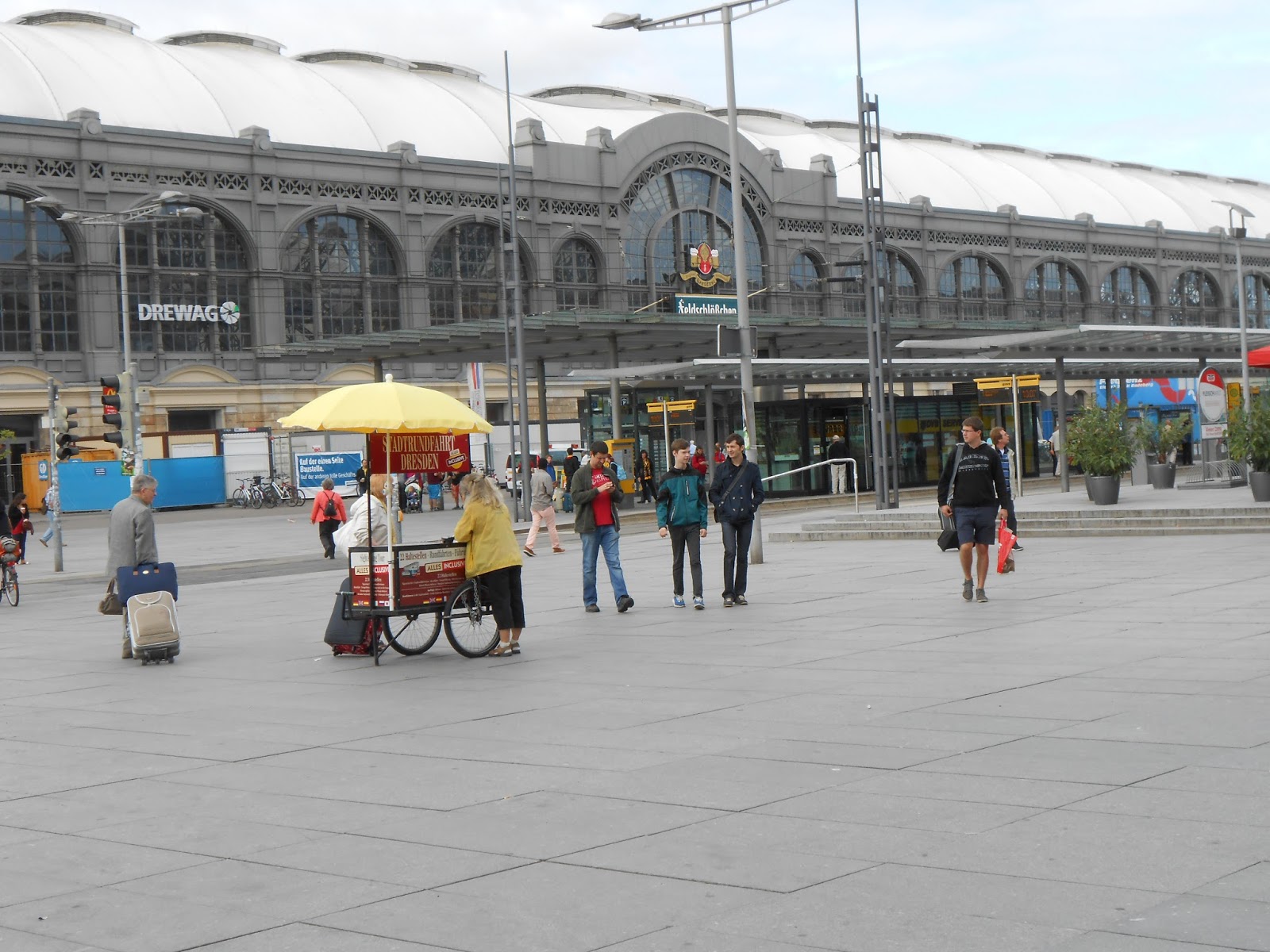
The Dresden train station where mass deomonstration
 took place in October 1989
The 15th international conference of the European Society of Women in Theological Research took place from August 28 to September 1, 2013 in Dresden, Germany. About 180 women from 16 countries attended the conference with the theme “New Horizons: Resistance and Visions.”

This was the first time that I had visited a city in the former East Germany. I looked forward to learning about the revolution of 1989 that changed the Eastern Bloc. We were shown a documentary about the mass demonstration in October of 1989. The former mayor of Dresden, a local priest, and others who had participated in the demonstration came to share their experience with us. They talked about the contribution of the Women for Peace movement and the roles of the churches in providing a space for people to discuss social reform.

The outcome of the demonstration in East Germany was drastically different from what happened at Tiananmen Square in Beijing earlier in the year, when the Chinese military crushed the students and demonstrators. The demonstration in Dresden was largely peaceful and the police had dialogues with leaders of the people. In November, the fall of the Berlin Wall signaled the end of the Cold War era.

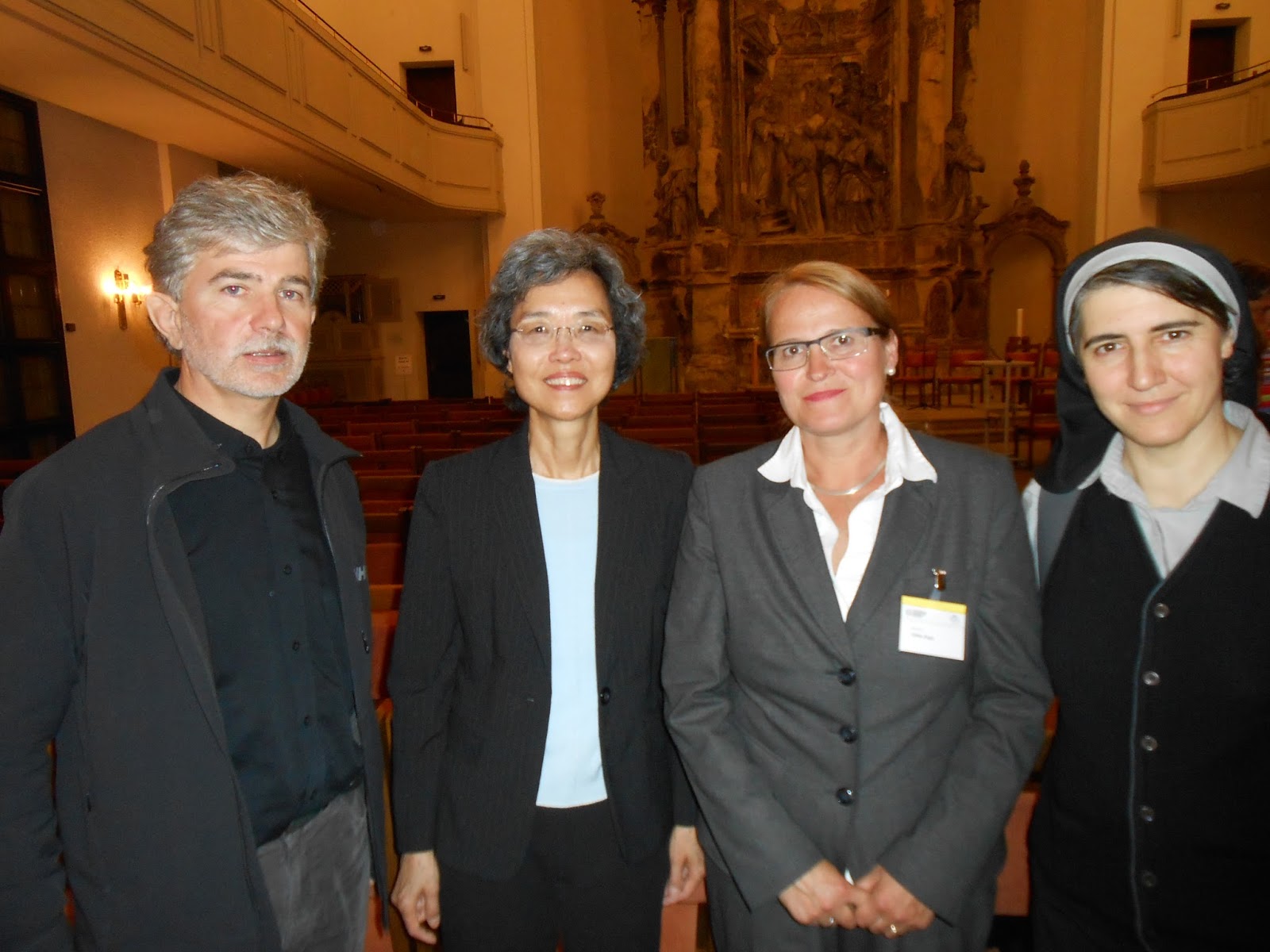
Joerg Rieger, Kwok Pui Lan, Ulrike Auga
from Germany and Teresa Forcades i Vila from Spain
Joerg Rieger and I spoke on “Occupy Heaven: Are God, Religion, and Politics beyond Rescue?” at a public forum during the conference. We were asked to speak about the Occupy Movement and the theological issues it had raised, based on our book Occupy Religion: Theology of the Multitude.

This was the third time that I have attended a conference of the Society and I noticed several important changes. Spanish has become an official language of the Society, together with German and English. About 20 women from Spain attended the conference and their participation was significant. A sizeable group came from Eastern European countries, including Croatia, Lithuania, Poland, Romania, Czech Republic, and Hungary.

In the past, women in Western Europe dominated in the meeting. The leaders of the Society have worked hard to include women from Southern and Eastern Europe. Younger researchers and graduate students were also given space to present their research.

The conference had three sub-themes: postcolonialism, post-secularism, and queer visions. I was glad to see that postcolonial and queer issues have been taken up seriously in the discussion, which I have not seen so much in previous meetings. Musa Dube from Botswana was invited to speak about postcolonial feminist interpretation of the Bible, while Mayra Rivera Rivera from Harvard Divinity School spoke about the key challenges for theologies of the body in the twenty-first century. Janet Jakobsen from Columbia University used the example of domestic work to illustrate the intersection of race, class, gender, and sexuality in thinking about new economies and solidarities.

Dresden was heavily bombed in WWII.
The Church of Our Lady was rebuilt and reopened in 2005
In addition to the plenaries, there were many panels. Two papers were of particular interest to me. Aurica Nutt of Germany presented a paper on queer ecologies and Christian theologies. Drawing from queer ecologies, she discussed why Christian theologies must analyze their discrimination against “unnatural behavior” and against the environment. An interesting point is how queer animals challenge us to think about “nature” and “queerness” differently.

Niki Papageorgiou and Angeliki Ziaka from Greece presented a paper on “Postcolonial Feminist Theological Discourse: Muslim and Christian Interactions.” They talked about the important work done by Islamic feminists on reinterpretation of Qur’an and Shari’a and why feminist theology and reinterpretation of religion could contribute to postcolonial political discourse. They also identified the similarities and differences of Muslim and Christian feminist movements.

European women in theological research face many difficulties and challenges. Jobs are scarce and many with doctorates cannot find teaching positions and have to work in churches and organizations. There seems to be a serious “backlash” or re-traditionalizing of religious traditions. Feminist theologians are increasingly under more pressure. During the conference, participants identified strategies and ways to support one another.

One of the goals I had in going to Dresden was to learn more about changes of women’s lives in Eastern Europe. I bought two books to help me understand the transformation after 1989. Gendering Post-Socialist Transition examines the effects of social and political changes on relationships between women and men, gender roles and representations, and normative discourses about femininity and masculinity in eleven countries in Central- and South Eastern Europe.

Gender and Religion in Central and Eastern Europe contributes to our understanding of theoretical and empirical approaches to the study of gender and religion in post-communist societies. In the United States, we do not have many opportunities learning from women in post-socialist countries. I hope to learn more about the transformation of women’s lives in Central and Eastern Europe in the future. 
 

Thursday, June 6, 2013

Asian Theological Summer Institute


“How can one develop a theological voice?” asked one of the participants at the Asian Theological Summer Institute.

“It is a lifelong process,” I replied.

The Asian Theological Summer Institute (ATSI), funded through the Luce Foundation, offered a four-day seminar for Asian and Asian American doctoral students at The Lutheran Theological Seminary in Philadelphia (LTSP) in the last week of May.

Dr. J. Paul Rajashekar, Luther D. Reed Professor of Systematic Theology at LTSP, saw the need to offer such a mentoring program because Asian and Asian American doctoral students often do not have the help and support of an Asian professor at their schools. The students came to present their dissertation proposals and work in progress and received feedback from a group of professors in different theological fields.

Just as in any art, developing your individual and unique voice in theological scholarship and style requires much learning, practice, coaching, and responding to feedback. But in many theological schools, Asian and Asian American doctoral students do not find the coaching they need to develop their scholarship and the community of discourse to try out new ideas.

Even though a student’s supervisor may be supportive, he or she may not know the social and cultural context of the student sufficiently well to give informed feedback. Worse, some professors treat the student as a “native informant”—the one to educate them about the particular culture or community.

One of the recurrent feedback from ATSI participants is that their work has been taken very seriously at the seminar. They do not need to explain their culture to people who have little knowledge about Asian and Asian American culture and history. The discussion can therefore move further along to explore the theological issues involved in the dissertation and the different theories and theological traditions to address them.

Developing your theological voice requires a lot of confidence in yourself. You need to have the courage to speak your mind, disagree with what has been said, offer a viewpoint that has not been tried, and/or suggest fresh new ideas.

Many educational systems in Asia are good at impacting knowledge, but not so good at encouraging students to challenge established authorities and think for themselves. Thus when Asian students come to the US to attend graduate schools, they often find the academic culture demanding and difficult to adjust to.

A dissertation needs to make some original contribution to the field. Where does that originality come from? Would it come from questions and issues arising from an Asian and Asian American context? Would it come from seeing a misfit of an established body of theories when applied to a new situation? Would it come from constructing new knowledge based on qualitative research? Would it come from developing new models that are culturally specific?

These are questions that beginning Asian and Asian American scholars often ask. In To Open Minds, Howard E. Gardner, an expert on multiple intelligences, compares Chinese and Western approaches to nurturing creativity, using learning Chinese painting as an example. He says that in China, one needs to spend years mastering the techniques and imitating great artists before developing one’s style. In sharp contrast, the American system values too much individuality and personal expression, sometimes at the expense of basic skills and training. He says that a balance between the two approaches will be beneficial.

The ATSI, now in its seventh year, has provided the space for more than 130 budding scholars to listen to themselves and others, hone their academic skills, and sharpen their theological thinking in a supportive environment. They have been encouraged to take the beginning steps, however tentative, to develop a life-long pursuit of scholarship and nurture a theological voice that is distinctly their own.

I wish I had such a seminar when I began. It has been a privilege to be able to accompany many of these students and play a small part in their journeys.