Showing posts with label postcolonialism. Show all posts

Tuesday, September 3, 2013

European Women in Theological Research

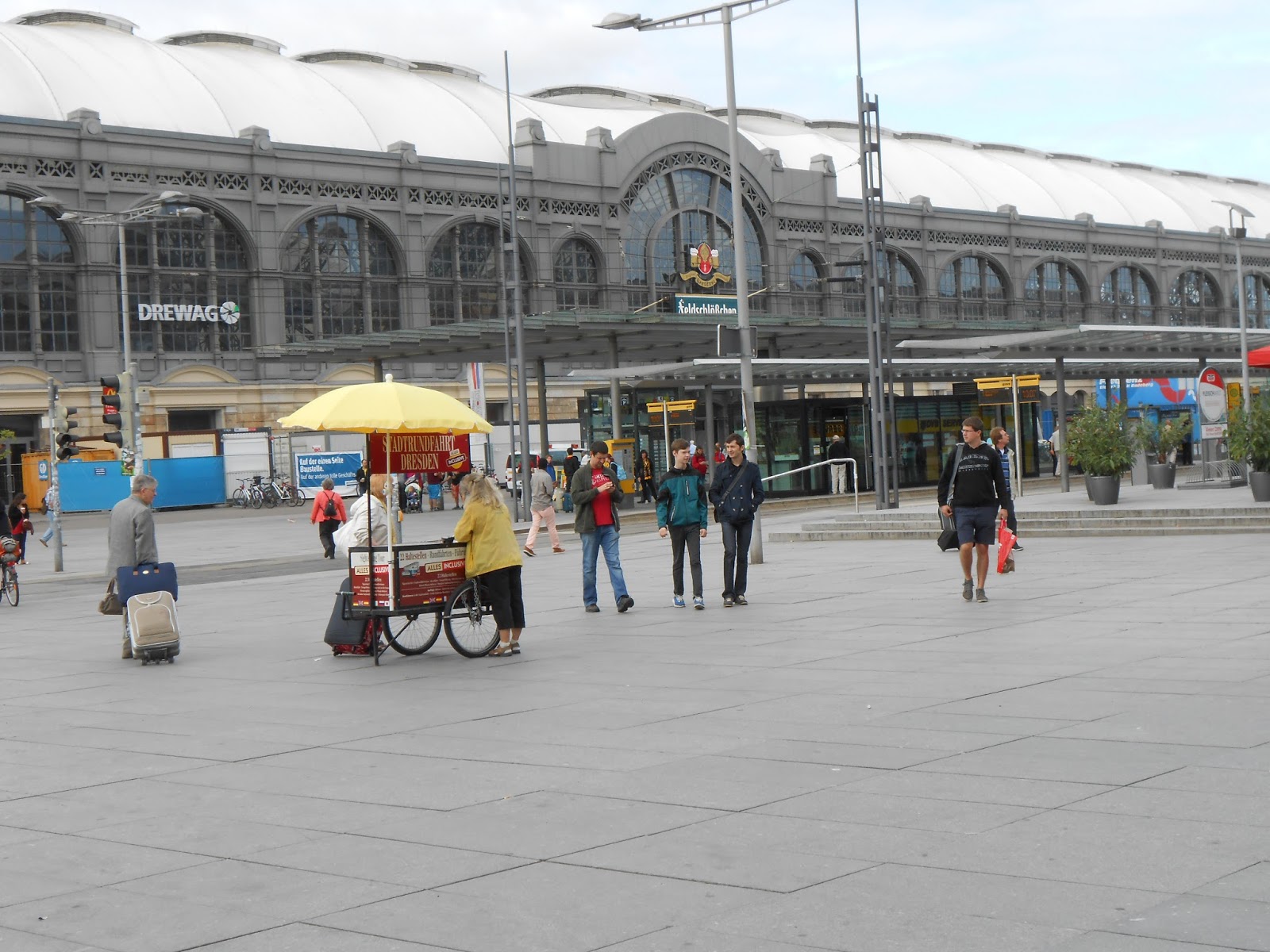
The Dresden train station where mass deomonstration
 took place in October 1989
The 15th international conference of the European Society of Women in Theological Research took place from August 28 to September 1, 2013 in Dresden, Germany. About 180 women from 16 countries attended the conference with the theme “New Horizons: Resistance and Visions.”

This was the first time that I had visited a city in the former East Germany. I looked forward to learning about the revolution of 1989 that changed the Eastern Bloc. We were shown a documentary about the mass demonstration in October of 1989. The former mayor of Dresden, a local priest, and others who had participated in the demonstration came to share their experience with us. They talked about the contribution of the Women for Peace movement and the roles of the churches in providing a space for people to discuss social reform.

The outcome of the demonstration in East Germany was drastically different from what happened at Tiananmen Square in Beijing earlier in the year, when the Chinese military crushed the students and demonstrators. The demonstration in Dresden was largely peaceful and the police had dialogues with leaders of the people. In November, the fall of the Berlin Wall signaled the end of the Cold War era.
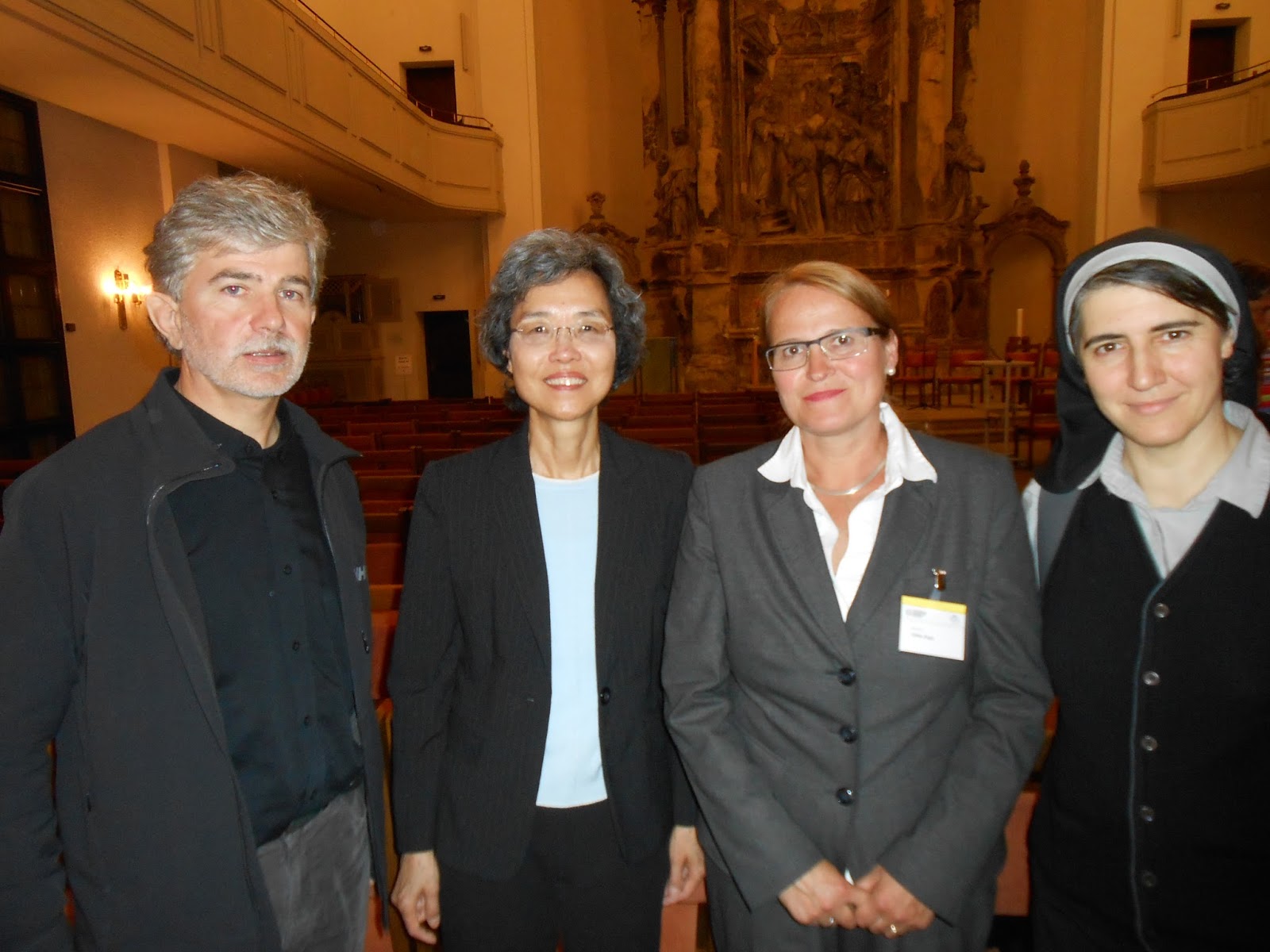
Joerg Rieger, Kwok Pui Lan, Ulrike Auga
from Germany and Teresa Forcades i Vila from Spain
Joerg Rieger and I spoke on “Occupy Heaven: Are God, Religion, and Politics beyond Rescue?” at a public forum during the conference. We were asked to speak about the Occupy Movement and the theological issues it had raised, based on our book Occupy Religion: Theology of the Multitude.

This was the third time that I have attended a conference of the Society and I noticed several important changes. Spanish has become an official language of the Society, together with German and English. About 20 women from Spain attended the conference and their participation was significant. A sizeable group came from Eastern European countries, including Croatia, Lithuania, Poland, Romania, Czech Republic, and Hungary.

In the past, women in Western Europe dominated in the meeting. The leaders of the Society have worked hard to include women from Southern and Eastern Europe. Younger researchers and graduate students were also given space to present their research.

The conference had three sub-themes: postcolonialism, post-secularism, and queer visions. I was glad to see that postcolonial and queer issues have been taken up seriously in the discussion, which I have not seen so much in previous meetings. Musa Dube from Botswana was invited to speak about postcolonial feminist interpretation of the Bible, while Mayra Rivera Rivera from Harvard Divinity School spoke about the key challenges for theologies of the body in the twenty-first century. Janet Jakobsen from Columbia University used the example of domestic work to illustrate the intersection of race, class, gender, and sexuality in thinking about new economies and solidarities.

Dresden was heavily bombed in WWII.
The Church of Our Lady was rebuilt and reopened in 2005
In addition to the plenaries, there were many panels. Two papers were of particular interest to me. Aurica Nutt of Germany presented a paper on queer ecologies and Christian theologies. Drawing from queer ecologies, she discussed why Christian theologies must analyze their discrimination against “unnatural behavior” and against the environment. An interesting point is how queer animals challenge us to think about “nature” and “queerness” differently.

Niki Papageorgiou and Angeliki Ziaka from Greece presented a paper on “Postcolonial Feminist Theological Discourse: Muslim and Christian Interactions.” They talked about the important work done by Islamic feminists on reinterpretation of Qur’an and Shari’a and why feminist theology and reinterpretation of religion could contribute to postcolonial political discourse. They also identified the similarities and differences of Muslim and Christian feminist movements.

European women in theological research face many difficulties and challenges. Jobs are scarce and many with doctorates cannot find teaching positions and have to work in churches and organizations. There seems to be a serious “backlash” or re-traditionalizing of religious traditions. Feminist theologians are increasingly under more pressure. During the conference, participants identified strategies and ways to support one another.

One of the goals I had in going to Dresden was to learn more about changes of women’s lives in Eastern Europe. I bought two books to help me understand the transformation after 1989. Gendering Post-Socialist Transition examines the effects of social and political changes on relationships between women and men, gender roles and representations, and normative discourses about femininity and masculinity in eleven countries in Central- and South Eastern Europe.

Gender and Religion in Central and Eastern Europe contributes to our understanding of theoretical and empirical approaches to the study of gender and religion in post-communist societies. In the United States, we do not have many opportunities learning from women in post-socialist countries. I hope to learn more about the transformation of women’s lives in Central and Eastern Europe in the future. 
 

Tuesday, November 15, 2011

Sugirtharajah's Exploring Postcolonial Biblical Criticism

R. S. Sugirtharajah and Pui Lan, 2010
What is the need for another introduction to postcolonial biblical criticism? Didn’t Sugirtharajah publish the highly acclaimed Postcolonial Criticism and Biblical Interpretation (Oxford 2002) almost a decade ago? The answers to these questions are simple: postcolonial biblical criticism keeps on developing.

This text begins with an introductory chapter on postcolonial theory and concludes with an afterword that discusses the future of postcolonial biblical criticism. It charts the development of the field, criticizes Orientalist reading practices, and offers helpful reading strategies. It includes a chapter by Ralph Broadbent summarizing the foundational texts in postcolonial biblical criticism.

On the back cover, Stephen D. Moore says the book is accessible to novices, but “old hands will also learn enormously from it.” I couldn’t agree more. 

The first chapter offers an updated development of the postcolonial condition. In the past, postcolonialism was based on what Gayatri Spivak has called a “South Asian model.” But today’s Empire is decentered and deterritorialized (Michael Hardt and Antonio Negri) and different from the previous colonial period. I detect urgency in the book to address economic inequity brought by globalization. Sugirtharajah said, in the early stage, postcolonial critics focused on political independence of former colonies. Then attention moved onto the dislocation and displacement of migrants and diasporans. Today, postcolonialism must address global hunger and the plight of the rural poor and peasants (20). In this way, the book wants to respond constructively to the persistent Marxist critiques of postcolonial biblical criticism by David Jobling, Roland Boer, and Gerald West.

I was struck by Sugirtharajah’s suggestion that biblical studies be considered an essential component of Oriental studies. In Orientalism, Edward Said already indicted the philological work of Ernest Renan, a major contributor to the historical quest of Jesus in the nineteenth century (author of Vie de Jésus, 1863). Placing biblical studies within the parameters of Oriental Studies allowed us to distinctly see how Orientalist archetypes have been reactivated in social-scientific approaches to biblical studies. Sugirtharajah denounced the Orientalist construction of the “Mediterranean” in the works of John Pilch and Bruce Malina. The use of cultural anthropology in biblical studies has created the binary of “us” versus “them,” and gives further support to the wars in Iraq and Afghanistan.

Said’s contrapuntal reading has been well known in postcolonial criticism. In this book, Sugirtharajah insightfully uses Said’s exposition of “late style” to discuss the writings of Paul and John. Said discusses the two contrasting late styles found in artists and thinkers during the twilight of their creative careers. One is wisdom, serenity, and harmony. The other fascinates Said for its display of “intransigence, difficulty, and unresolved contradiction.” In music (Said was an accomplished pianist and music critic), Beethoven, Richard Strauss, and Mozart’s “Cosi  fan tutte” demonstrated this late style.

Sugirtharajah says that Paul’s Romans represents the first late style. According to Acts, he was a troublemaker and arrested for resisting Roman authorities numerous times. But in Romans, he became mellow and told his followers to submit to the authorities (Rom. 13). John’s Book of Revelation represents the other late style, if John is taken to be the same author of the Fourth Gospel. The Book of Revelation is uncompromising in its anti-imperial stance, in sharp contrast to the apolitical nature of the Gospel of John.

The volume addresses the issue that male postcolonial biblical critics have not paid attention to feminist issues. Broadbent’s chapter includes a section on “postcolonialism and feminism” (83-86). Sugirtharajah points his readers to resources on mutual criticism between feminists and postcolonial critics (19-20), criticizes the misogyny in the Book of Revelation (161), and challenges the use of gender stereotypes in the construction of the Mediterranean (107-108). These are good attempts – but much more can be said.

The contribution of queer studies to postcolonial criticism is glaringly missing in the book. The leading queer theorist Judith Butler has written on war, Zionism, and American imperialism. Marcella Althaus-Reid’s work and some of the chapters in The Queer Bible Commentary include analyses of imperial power. Contrary to Sugirtharajah’s comment that the Song of Songs falls outside the concerns of postcolonalism (53), Christopher King’s reading of the Song in The Queer Bible Commentary shows that transgressive love prefers the outsider. This has implications for the construction of the “other,” an issue discussed throughout Sugirtharajah’s book. The intersection between postcolonialism and queer studies has been broached in other fields and ought to be included in discussing the future of postcolonial biblical criticism.

*This review first appeared in the Journal of Postcolonial Networks, November 2011.

Monday, January 31, 2011

Postcolonial Spirituality?


I am teaching a course on Spirituality of Contemporary World in the spring semester. I have 16 students in my class and we will be reading Christian authors (e.g. Sandra Schneiders, Marjorie Thompson, Owen Thomas, Michael Battle) as well as the Dalai Lama's Toward a True Kinship of Faiths and Thich Nhat Hanh's Teachings on Love.

We are very fortunate to have a colleague Katherine Stiles, who had an audience with the Dalai Lama in Dharamsala in northern India in January. She is going to share with us her exciting pilgrimage with the EDS community later in the spring.

I have long admired the work of Vietnamese Zen Master Thich Nhat Hanh and have introduced him to my students. I visited his Plum Village near Bordeaux in southwest France some years ago and had a most tranquil and transforming experience.

Postcolonial spirituality must be interfaith, fluid, hybrid, and not be boxed.

This I know. What I am less sure is how traditional Christian practices fit into the picture.

For example how can you go back to the pre-critical stage of reading the Bible "spiritually"? The Christian tradition has the venerable tradition of Lectio Divina, which has been practiced for centuries. The four basic phases of this spiritual reading consist of lectio, meditatio, oratio, and contemplatio. You can read more about this in Thompson's Soul Feast.

This method of reading is meant to inculcate submission to the authority of Scripture as the Word of God. But this can be "dangerous to your health" both physically and spiritually, if you were a woman and a postcolonial.

How can communal worship be a source of spiritual sustenance when Rite Two of the Book of Common Prayer (the most often used rite for Eucharist in the Episcopal churches) is full of androcentric language? Even though the priest can inclusivize it, your mind is still constantly distracted.

What about the hymns we sing--still so full of Christian triumphant images, and sometimes very militaristic.

As this semester progresses, I would like to reflect more deeply on how we can reclaim and reconstruct the Christian spiritual practices, so that they are no longer relics of the past, but joyful guides for Christian living.

I wrote this poem in 1992 when I attended the Third Assembly of the Ecumenical Association of Third World Theologians in Nairobi. I asked the theologians present images that had come up for them during the conference and built a poem around them. Together we read this during our first spirituality class.

We see the Spirit in the ancient gong
Calling us to silence, to listen
The embryonic rhythm of life
Vibrating, resounding, all-embracing

We see the Spirit in the water
Cleansing our body, healing our soul
We drink from the same cup
Renewing, sustaining, replenishing

We see the Spirit in the fire
Errupting with passion, like a volcano
Our anger against injustice
Burning, glowing, fast-spreading

We see the Spirit in the circle
Learning Miriam's dance, taking first steps
In solidarity with all women
Dancing, chanting, spiraling

We see the Spirit in the colors
Taking pride in our culture, our rites
Black, yellow, brown, and white
Celebrating, living, rejoicing

We see the Spirit in our bonding
Confessing our brokenness, our division
Hope we offer to each other
Visioning, struggling, empowering