Saturday, November 30, 2013

Religion, Theology, and Class


Religion, Theology, and Class: Fresh Engagements after Long Silence edited by Jeorg Rieger has just been published by Palgrave Macmillan. The book wants to re-emphasize class as a critical category in theology and ethics, because people tend to focus more on gender, race, and sexuality issues in North America. Divided into three parts, the book presents new definitions of class, situates religion and class in the context of early Christianity and the United States, and examines the relation between class, poverty, gender and race. 

Gary J. Dorrien, Stephanie Mitchem, Santiago H. Slabodsky, Susan B. Thistlethwaite, and I reviewed the book at the annual meeting of the American Academy of Religion on November 24, 2013 at Baltimore, Maryland. My review used a postcolonial perspective to examine the contribution of the book.

Postcolonial theorists have criticized the limits of the concept of class in classical Marxist theory, based as it was on the development of industrialized and capitalist societies. It is less useful to study pre-industrialized societies and other forms of oppression in society. They have also pointed out the Orientalist biases in Marxist writings.

In this book, the contributors seek to bring the concept of class up to date in the context of global capitalism. The nuanced and pluralistic approach is most helpful and it points to the difficulties of formulating a generally accepted theory of class. Less is said in the book, however, about the vision or shape of an alternative global economic system and the role religion and theology will take part in it.

While the poor are often mentioned, they are discussed in the context of Marxist or other theories. The Occupy Movement is mentioned in several chapters and offered as a clear example of people rising against the transnational capitalist class. In addition, Vítor Westhelle speaks briefly about the transgression and resistance of migrant people, while Pamela K. Brubaker refers to the factory workers in Mexico, who struggle to live out according to the values of sustenance economy in relation to transnational production. Toward the end of her chapter, Brubaker also mentions Vandana Shiva’s work on sustenance economy and nature’s economy to contest the dominant market economy.

Corey D. B. Walker’s chapter presents a sustained reflection on class from a subaltern perspective by offering an account of “thinking blackness” in the work of black religious scholars and theologians. He challenges us to work for “a categorical infusion of an/other logic the opens up onto new and that in/forms novel conceptual intelligibility as well as the orientation of human life.” Walker finds Walter Mignolo’s concept of “colonial difference” and Anibal Quijano’s concept of “coloniality of power” valuable for his project.

Edward P. Antonio’s important essay on “Black Theology and Postcolonial Discourse” in the Cambridge Companion to Black Theology has brought to my attention the often unexplored overlapping concerns of black and postcolonial theologies and possibilities for mutual learning.

Joerg Rieger
I would like to see the following areas articulated in future discussion about religion, theology, and class. Postcolonial theorists discuss the intimate relationship between the colonizers and the colonized, such as mutual inscription, collaboration, attraction, and repulsion. The book often presents stark contrast between the rich and the poor and toward the end, Rieger says that dualism is necessary to articulate the realities of class struggle. But class in today’s global capitalism must be seen as more fluid and multifaceted, and indeed in relational terms.

While the exploitation by the transnational capitalist elites should be criticized, we need to investigate the role of the poor and the middle class in collaborating with or sustaining the global economic system. This is not to blame the victims, but to see how global capitalism interpellates different kinds of subjects through its ideologies and practices. Without articulating how and why the poor are absorbed, coopted, and bought into the system and become the instrument of their own oppression, we cannot see through the maze to propose alternatives and mobilize resistance.

I hope that gender and sexuality will feature more prominently in future discussion of religion, theology, and class. Except for Brubaker’s chapter, other chapters have either left these categories out or mentioned them only in passing. The work of Marcella Althaus-Reid has convincingly shown the intersection between heterosexism and colonialism and empire building. We need to investigate for example how gender is racialized and has a class dimension, how race is genderized, and inflected by class, and how class intersects with race and gender especially in the consumerist culture.

Finally, I would like to see contributions from China, Vietnam, and Eastern Europe as their move from Communism to adopting capitalist measures will offer another perspective to look at how religion and theology is inflected by class and economic injustice in these rapidly changing societies.  I hope the publication of the book and this panel will stimulate further interdisciplinary research and conversation.
Tuesday, September 3, 2013

European Women in Theological Research

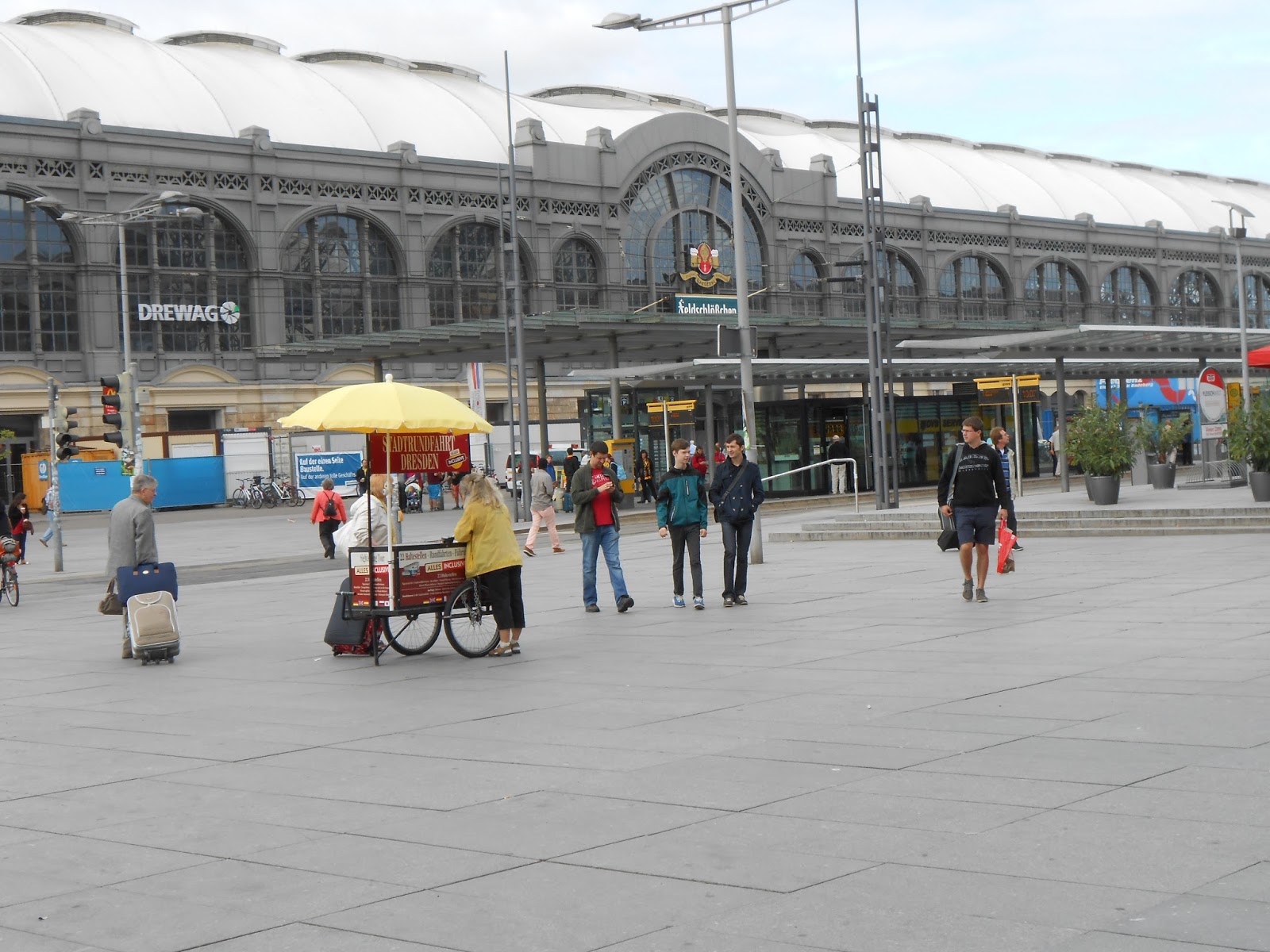
The Dresden train station where mass deomonstration
 took place in October 1989
The 15th international conference of the European Society of Women in Theological Research took place from August 28 to September 1, 2013 in Dresden, Germany. About 180 women from 16 countries attended the conference with the theme “New Horizons: Resistance and Visions.”

This was the first time that I had visited a city in the former East Germany. I looked forward to learning about the revolution of 1989 that changed the Eastern Bloc. We were shown a documentary about the mass demonstration in October of 1989. The former mayor of Dresden, a local priest, and others who had participated in the demonstration came to share their experience with us. They talked about the contribution of the Women for Peace movement and the roles of the churches in providing a space for people to discuss social reform.

The outcome of the demonstration in East Germany was drastically different from what happened at Tiananmen Square in Beijing earlier in the year, when the Chinese military crushed the students and demonstrators. The demonstration in Dresden was largely peaceful and the police had dialogues with leaders of the people. In November, the fall of the Berlin Wall signaled the end of the Cold War era.

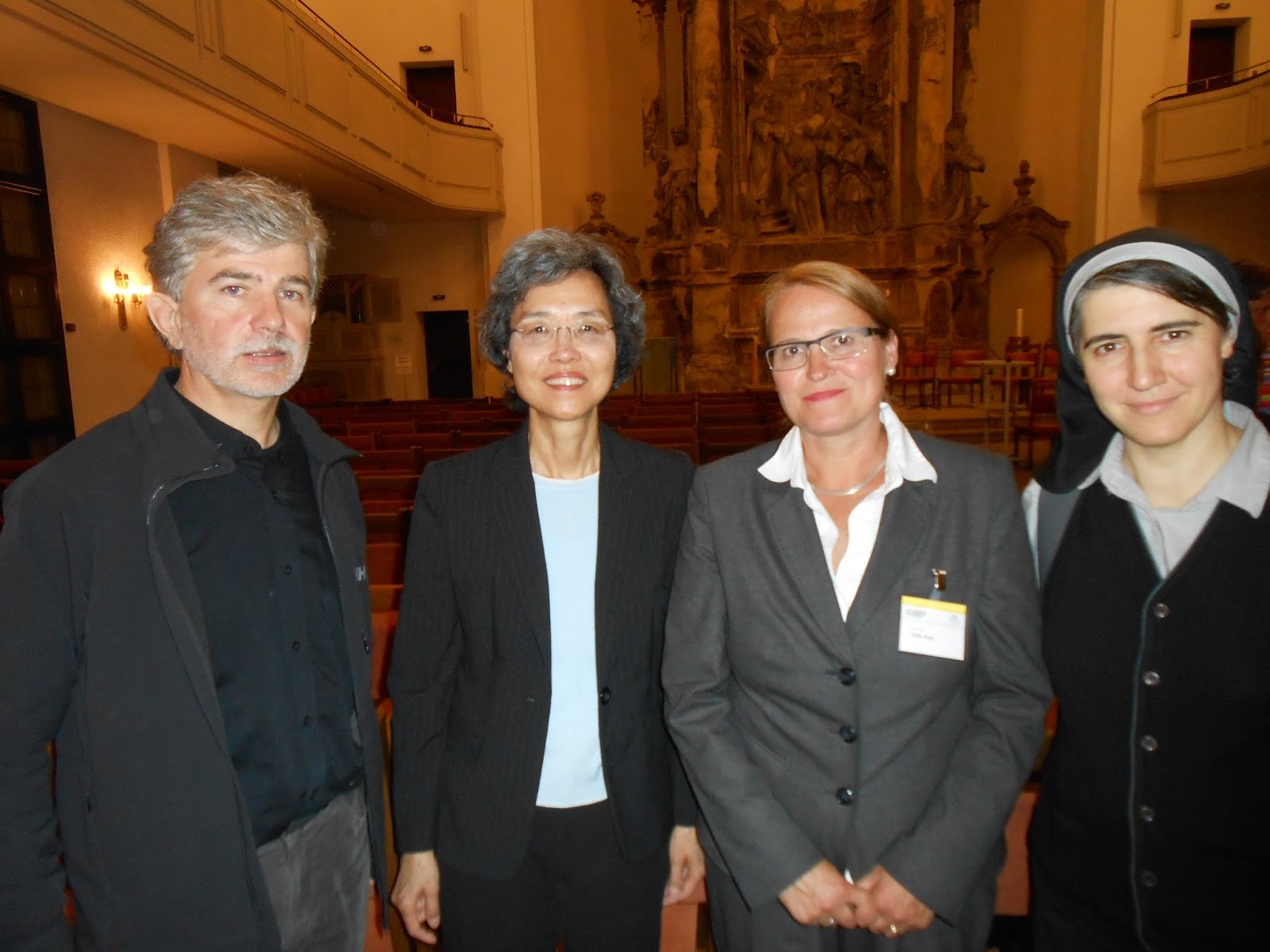
Joerg Rieger, Kwok Pui Lan, Ulrike Auga
from Germany and Teresa Forcades i Vila from Spain
Joerg Rieger and I spoke on “Occupy Heaven: Are God, Religion, and Politics beyond Rescue?” at a public forum during the conference. We were asked to speak about the Occupy Movement and the theological issues it had raised, based on our book Occupy Religion: Theology of the Multitude.

This was the third time that I have attended a conference of the Society and I noticed several important changes. Spanish has become an official language of the Society, together with German and English. About 20 women from Spain attended the conference and their participation was significant. A sizeable group came from Eastern European countries, including Croatia, Lithuania, Poland, Romania, Czech Republic, and Hungary.

In the past, women in Western Europe dominated in the meeting. The leaders of the Society have worked hard to include women from Southern and Eastern Europe. Younger researchers and graduate students were also given space to present their research.

The conference had three sub-themes: postcolonialism, post-secularism, and queer visions. I was glad to see that postcolonial and queer issues have been taken up seriously in the discussion, which I have not seen so much in previous meetings. Musa Dube from Botswana was invited to speak about postcolonial feminist interpretation of the Bible, while Mayra Rivera Rivera from Harvard Divinity School spoke about the key challenges for theologies of the body in the twenty-first century. Janet Jakobsen from Columbia University used the example of domestic work to illustrate the intersection of race, class, gender, and sexuality in thinking about new economies and solidarities.

Dresden was heavily bombed in WWII.
The Church of Our Lady was rebuilt and reopened in 2005
In addition to the plenaries, there were many panels. Two papers were of particular interest to me. Aurica Nutt of Germany presented a paper on queer ecologies and Christian theologies. Drawing from queer ecologies, she discussed why Christian theologies must analyze their discrimination against “unnatural behavior” and against the environment. An interesting point is how queer animals challenge us to think about “nature” and “queerness” differently.

Niki Papageorgiou and Angeliki Ziaka from Greece presented a paper on “Postcolonial Feminist Theological Discourse: Muslim and Christian Interactions.” They talked about the important work done by Islamic feminists on reinterpretation of Qur’an and Shari’a and why feminist theology and reinterpretation of religion could contribute to postcolonial political discourse. They also identified the similarities and differences of Muslim and Christian feminist movements.

European women in theological research face many difficulties and challenges. Jobs are scarce and many with doctorates cannot find teaching positions and have to work in churches and organizations. There seems to be a serious “backlash” or re-traditionalizing of religious traditions. Feminist theologians are increasingly under more pressure. During the conference, participants identified strategies and ways to support one another.

One of the goals I had in going to Dresden was to learn more about changes of women’s lives in Eastern Europe. I bought two books to help me understand the transformation after 1989. Gendering Post-Socialist Transition examines the effects of social and political changes on relationships between women and men, gender roles and representations, and normative discourses about femininity and masculinity in eleven countries in Central- and South Eastern Europe.

Gender and Religion in Central and Eastern Europe contributes to our understanding of theoretical and empirical approaches to the study of gender and religion in post-communist societies. In the United States, we do not have many opportunities learning from women in post-socialist countries. I hope to learn more about the transformation of women’s lives in Central and Eastern Europe in the future. 
 

Thursday, June 6, 2013

Asian Theological Summer Institute


“How can one develop a theological voice?” asked one of the participants at the Asian Theological Summer Institute.

“It is a lifelong process,” I replied.

The Asian Theological Summer Institute (ATSI), funded through the Luce Foundation, offered a four-day seminar for Asian and Asian American doctoral students at The Lutheran Theological Seminary in Philadelphia (LTSP) in the last week of May.

Dr. J. Paul Rajashekar, Luther D. Reed Professor of Systematic Theology at LTSP, saw the need to offer such a mentoring program because Asian and Asian American doctoral students often do not have the help and support of an Asian professor at their schools. The students came to present their dissertation proposals and work in progress and received feedback from a group of professors in different theological fields.

Just as in any art, developing your individual and unique voice in theological scholarship and style requires much learning, practice, coaching, and responding to feedback. But in many theological schools, Asian and Asian American doctoral students do not find the coaching they need to develop their scholarship and the community of discourse to try out new ideas.

Even though a student’s supervisor may be supportive, he or she may not know the social and cultural context of the student sufficiently well to give informed feedback. Worse, some professors treat the student as a “native informant”—the one to educate them about the particular culture or community.

One of the recurrent feedback from ATSI participants is that their work has been taken very seriously at the seminar. They do not need to explain their culture to people who have little knowledge about Asian and Asian American culture and history. The discussion can therefore move further along to explore the theological issues involved in the dissertation and the different theories and theological traditions to address them.

Developing your theological voice requires a lot of confidence in yourself. You need to have the courage to speak your mind, disagree with what has been said, offer a viewpoint that has not been tried, and/or suggest fresh new ideas.

Many educational systems in Asia are good at impacting knowledge, but not so good at encouraging students to challenge established authorities and think for themselves. Thus when Asian students come to the US to attend graduate schools, they often find the academic culture demanding and difficult to adjust to.

A dissertation needs to make some original contribution to the field. Where does that originality come from? Would it come from questions and issues arising from an Asian and Asian American context? Would it come from seeing a misfit of an established body of theories when applied to a new situation? Would it come from constructing new knowledge based on qualitative research? Would it come from developing new models that are culturally specific?

These are questions that beginning Asian and Asian American scholars often ask. In To Open Minds, Howard E. Gardner, an expert on multiple intelligences, compares Chinese and Western approaches to nurturing creativity, using learning Chinese painting as an example. He says that in China, one needs to spend years mastering the techniques and imitating great artists before developing one’s style. In sharp contrast, the American system values too much individuality and personal expression, sometimes at the expense of basic skills and training. He says that a balance between the two approaches will be beneficial.

The ATSI, now in its seventh year, has provided the space for more than 130 budding scholars to listen to themselves and others, hone their academic skills, and sharpen their theological thinking in a supportive environment. They have been encouraged to take the beginning steps, however tentative, to develop a life-long pursuit of scholarship and nurture a theological voice that is distinctly their own.

I wish I had such a seminar when I began. It has been a privilege to be able to accompany many of these students and play a small part in their journeys.

Thursday, March 28, 2013

Anglican Women on Church and Mission

The Anglican Communion is in crisis. The battle over homosexuality, with its intense media coverage, threatens to rip the Church apart. The debates on women bishops in the Church of England caused anger and frustrations among female clergy and their supporters. Some conservative Anglican bishops and their followers have formed a Fellowship of Confessing Anglicans, chastising the Church as having gone astray from true biblical teaching. These controversies epitomize the challenges facing the Communion and touch on fundamental issues such as the crisis of Anglican identity, the nature of authority and provincial autonomy, contrasting views on biblical interpretation, and ecumenical relations with other churches. The tenor of the debates is also influenced by the shift of Christian demographics from the global North to the global South. If the contentious issue of women’s ordination did not break the Anglican Church apart in the 1970s, some are less optimistic that the Communion can weather the present storm and find ways to remain together.

Yet even as gender and sexuality issues remain at the heart of these debates, voices of women from the Communion have not been clearly heard or appreciated. Media coverage and church pronouncements tend to focus on the opinions of bishops, as if they could represent the range of diversity within the member churches, or of spokespersons of various Anglican networks and agencies, who are mostly male and clergy. The voices of lay people and women are marginalized, even though women make up the majority of many churches. This groundbreaking volume attempts to fill this gap by inviting female church leaders, scholars, and theological educators from across the Communion to share their reflections on the Anglican Church and its mission. An anthology such as this makes a unique contribution because there are very few substantial works by women from different parts of the Communion. It is even rarer for the majority of the book’s authors to have grown up in the global South, bringing with them the rich textures and multilayered experiences of the Anglican Church.

The book originated at a conference for Anglican female theological educators at Canterbury, United Kingdom, in the spring of 2009. The women gathered became very conscious of the fact that we had few women leading theological schools in the Anglican Communion. Although there are several books on Anglican women’s history, mission, and struggles for leadership, they are mostly limited to a single country and do not cover the Communion as a whole. Judith A. Berling, Jenny Te Paa, and I decided to coedit this book to broaden the conversation.

The book is divided into two parts. Part one provides Anglican historical and theological perspective on the Church. Contributors include Ellen K. Wondra, Jane Shaw, Wendy Fletcher, Jenny Te Paa, and I. We discuss the transition from a colonial church to a global Communion, the problems of authority, the debates on sexuality, women's struggle for ordination, and women’s leadership development in the Communion. 

Part two focuses on Anglican women and God’s mission. Gulner E. Francis-Dehqani, Cordelia Moyse, Esther M. Mombo, Denise M. Ackermann, Clara Luz Ajo Lázaro, and Judy Berinai are the contributors. The chapters discuss the involvement of women in the Church Mission Society in Iran, the work of the Mothers’ Union, the Church’s involvement in poverty alleviation in Africa, the Church and the HIV and AIDS pandemic, cultural diversity and women’s spirituality within the Communion, and women witnessing Christ in a Muslim context. 

We hope that this book will promote dialogue and scholarship on women in the Communion. We are very grateful to those faithful Anglican women who have gone before us, and we hope that women in the upcoming generation will be given greater responsibilities and leadership opportunities in the Church.

 
*Adapted from Anglican Women on Church and Mission © 2013 the Church Publishing Inc. All rights reserved. Used by permission of Church Publishing Incorporated, New York, NY.


Saturday, March 23, 2013

I Went to the Emergency Room

Last Saturday night I went to an emergency room in Evanston, Illinois. I had spasms on my right chest. Luckily it was on the right side and not the left side (where the heart is located). Since I needed to fly back to Boston the next morning, the nurse I spoke to at my primary care doctor’s office advised me to go to the ER to make sure I was all right.

I am a relatively healthy person. This was the second time I have gone to an emergency room. The first time was almost ten years ago when I had vertigo. I was very fortunate that my colleague Gale Yee attended the conference in Evanston with me and she kindly accompanied me to the ER.

I didn’t know having chest pain would give me some privileges at the ER. I didn’t have to wait and was swiftly seen by a nurse assistant, who checked my vital signs. Then the health care professionals did the ECG, took chest x-rays, and ordered the blood tests.

I was not very nervous since I did not have sweating, shortness of breath, dizziness, and other symptoms of a heart attack. But fear crossed my mind when I gave Gale my spouse’s cell phone number, just in case.

Thank God, my ECG, x-rays, and blood work were normal, except for low potassium. I was able to board the plane the next day to go home.

What happened in the next few days was a learning experience. For first of all, I had to find out what caused the spasms.

I googled chest pain and chest spasm on the right side and found so much materials. Websites like the Mayo Clinic’s provide very detailed and useful information on all forms of chest pain. But what I benefit most are those forums in which patients share their symptoms, treatments, and results. These completely unknown strangers suddenly seem like friends to me and I am not so alone.

Pain makes us connect with our body in a special way. Pain is difficult to describe. People who have not had debilitating muscle spasms might sympathize with you, but they might not fully comprehend how you feel. For example, one person in a forum said that finding other people suffer from similar pain made her feel that she was not insane.

It was difficult for my doctor to diagnose since I did not have symptoms associated with heartburn or acid reflux at the time, and the pain was located under the right collarbone. My doctor prescribed muscle relaxer, but it upset my stomach so much that I couldn’t sleep.

I saw that a person in one of the forums suggested putting some salt on the tongue and swallowing it. I didn’t know if it would work but I had to do something to stop the pain. So in the middle of the night, I went to the kitchen to try it. I was so tired that I dozed off afterward. It might or might not have worked.

On the next day, four little red bumps started to appear on the side of my body. At first I thought I have scratched my skin and didn’t pay attention. Then the rash spread to the back and the breast. And as if this wasn’t bad enough, symptoms of acid reflux began to develop. When I went back to see my doctor, she said I had shingles. Oh My God!

I was given medicines to treat the shingles and acid reflux, but I still needed to manage the pain. This was where Chinese medicine came in. My acupuncturist has been trained in Western medicine and she understood that shingles occurs when the virus that causes chickenpox gets activated. But in Chinese traditional medicine, shingles is caused by heat in the liver and gallbladder. This happens when one is stressed, too tired, and the body loses its balance. Although I do not understand why it has to do with the liver and gallbladder, Chinese medical system always reminds me that the body is a wholistic system, and overall balance is important.

I thought some Tai Chi movement would help. I consulted Dr. Paul Lam’s Tai Chi exercises for beginners and for arthritis on Youtube. I have had Tai Chi lessons before and found his exercises easy for the joints and for a body in pain.

Pain in the body often brings one to a threshold, because one starts to ask many questions about the body and about life. I have always believed that sickness is the body sending a message and I have to learn to listen.

It is surprising that shingles comes during my sabbatical, when I should have more time to relax and rest. But when I look at my sabbatical proposal, I recognize that I have intended to do even more than when I am teaching, including books and projects, planning a course that involves international participants, speaking engagements, and international travels. A person half my age might have found this demanding. I need to rethink the pace of life and to set priorities and to say no to more things.

Illness has its social dimension and healing comes when one is supported by family and friends. I am very fortunate to have a strong social network. My spouse volunteered to postpone his travel if needed to take care of me; my daughter who lives in Manhattan asked if I needed her to come home. Colleagues and friends who heard about my illness sent their prayers and healing energy. Several of them who have experienced chest pains and muscle spasms told me how they have dealt with them. I am very grateful to them for their loving care.

Just as I am having these pains in my body, Sheryl Sandberg, the chief operating officer of Facebook has started a national conversation on women, work, and leadership through her book Lean In. She encourages women to “sit at the table,” take greater responsibilities, and pursue their goals. She notes that sometimes women are the ones who sabotage ourselves. There is truth to what Sandberg has said because women must overcome both internal and external barriers to be able to succeed.

But I appreciate the wisdom of Arianna Huffington who says that in order to lean in, women must first lean back. By leaning back, she means taking care of our well-being, having enough sleep, and rejecting the culture of “time macho.” Huffington, 18 years older than Sandberg, learned this in a hard way. In 2007, while spending long hours at the Huffington Post, she had to cart her youngest daughter around the country for college visits. She fainted because of exhaustion and hit her head on her desk and broke her cheekbone.

Huffington wrote, “The world needs women to redefine success beyond money and power. We need a third metric, based on our well-being, our health, our ability to unplug and recharge and renew ourselves, and to find joy in both our job and the rest of our life.”

Both Sandberg and Huffington are millionaires who have a team of people to help them take care of family, children, scheduling, and other personal needs. I wonder how the corporate structures and the workplace need to change so that ordinary women, and not just wealthy and successful women, can lean in and lean back at the same time.

Before these changes happen, we have to listen to the messages of the body and develop a way to eat a healthy diet, exercise, and reduce stress. For a workaholic like me, this is not easy, because I actually enjoy doing the work I do.

This blog is not meant to give medical advice or intended to replace the advice of a doctor. 

Saturday, January 26, 2013

Challenges of Theological Field Education Today

Williamsburg, Virginia
I have addressed theologians, biblical scholars, practical theologians, and even supervisors of clinical pastoral education. But I have never spoken to a gathering of directors of theological field education, until last Thursday.

The 32nd biennial consultation of the Association of Theological Field Education (ATFE) was held at Williamsburg, Virginia. I was invited to deliver the keynote address on “From Pasts to Possibilities: Religious Leadership in 2040.” It was my first time to this historic city, the capital of the Colony of Virginia from 1699 to 1780. Together with Jamestown and Yorktown, Williamsburg formed the Historic Triangle of colonial Virginia.

About 130 people attended the consultation: the majority was from the United States and about five each from Canada and Australia. Almost half of the participants have served as directors of theological field education for less then ten years. About ten people attended the consultation for the first time.

Our hotel is located across from the College of William and Mary, the second oldest institution of higher education in the U.S., established in 1693. The College was named after the monarchs of England, Scotland, and Ireland at the time. The portraits of William and Mary are hung at a parlor in the hotel. This was the first time that I saw the portraits of English monarchs in an American building. The Colony of Virginia was the first English colony in the so-called New World.

About fifty yard from the hotel is the historic First Baptist Church, which dated back to the 1700s, when the slaves and free blacks wanted to have their worship separated from their slave owners. After the Civil War, the Church provided support for the newly freed blacks.

Given the rich history of the city, I talked about the colonial past, the abolition movement, and the Civil Rights movement and pointed to nation building as imperial formation in the United States.

I challenged the field educators to be bold in the formation of religious leaders for 2040, when there will be no racial and ethnic majority in the U.S. We will need flexible, agile, and forward-looking leaders of faith communities in preparation for a racially, culturally, and religiously diverse United States.

Instead of sending seminarians to learn from experienced supervisor-mentors in church settings, which they are already familiar with, directors of field education should ask, “What kind of new field sites and new experiences our students would need in order to prepare for a much more diverse church and society leading to 2040?”

What if we see theological field education not as apprenticeship, but more like a laboratory—a place to try out and test new things?

At the gathering, I learned that some schools have already tried out new models of field or contextual education. For example, at Vancouver School of Theology, second year students work in studios—non-traditional field sites—to learn about creative leadership and ministry. In their senior year, students do their field work in church contexts.

I also learned that in some Roman Catholic schools, conversations about field education are often conducted in global and cross-cultural perspectives, because of the diversity brought by international students, who are priests and nuns from the Global South.

After my keynote address, many people came up to me to discuss and share their work. My heart was warmed when a younger director who attended the consultation for the first time told me that my address had broadened his understanding of his vocation as a director of field education.

Another person came to tell me about summer field education in the national parks, which I have not heard about. The students meet all kinds of people at the parks and offer pastoral care and counseling for people who need them.

I am very grateful for the privilege of addressing the directors of theological field education. Special thanks go to my colleague William Kondrath, director of field education and professor of pastoral theology at my school. Kondrath is a senior member of ATFE, having served as a director of field education for nearly two decades. Conversations with him helped me understand the changing contexts of theological field education today.

Monday, December 10, 2012

Church in the Round

St. John's Memorial Chapel
Sermon preached at St. John's Memorial Chapel, December 6, 2012

St. John’s Memorial Chapel at the Episcopal Divinity School was built in the nineteenth century. I asked historian David Sigenthaler what chapel and worship was like when he was a student at the school in the 1950s.

At that time the altar was set against the east wall, the faculty sat up in the chancel, and the students sat in the pews facing each other. Each would have an assigned seat and chapel during that time was compulsory. The design of sacred space mirrored the hierarchical setup of the community. In the 1960s when Christopher Durasingh and Ed Rodman were students, the pews were removed and replaced with chairs.

In 1992 when I joined the school, the altar was brought forward to the crossing and the ambo was placed on the west side near the entrance. The students sat facing each other.

To honor Brett Donham who renovated St. Paul’s at Brookline after the fire in 1976 and our presider Rev. Jeffrey Mello, the rector of St. Paul’s, we have created a worshipping space modeling after St. Paul’s in which the congregation and the choir sit surrounding the altar. Donham talked about the rationale of why he designed the church in such a way:

“The traditional forms of church buildings, with everyone facing in the same direction and with the ‘expert’; the intermediary or interpreter, on a raised stage addressing an audience is the antithesis of gathering in community.”

St. Paul's Episcopal Church, Brookline, MA
Today many churches are recovering the early roots of Christianity. Donham continues, “In these places people gather in community to offer praise and thanksgiving, to reflect on scripture, to share stories about Jesus Christ and his impact on their lives, to share a commemorative meal, and through this to come into communion with Christ, and with one another. These are communal activities, with many players, several centers of action and movement, and require the ability to see one another and feel as a gathered body.”

We have shifted the feast days and celebrate today the feast of Macrina, theologian, teacher, and monastic. I would like to invite you to reflect for a moment on the image of the church in the round.

Several things in Macrina’s life lead me to think that she will be open to the church in the round. Her brothers Basil and Gregory of Nyssa were bishops and renowned theologians in Cappadocia in modern day Turkey. Macrina as their elder sister admonished them to lead a life of simplicity and not to depend on their knowledge and rhetorical skills, their wealth, and their high positions in church and society.

In the Life of St. Macrina, Gregory said Macrina persuaded her mother to give up all showy style of living and the services of domestics. She urged her mother to share the life of the maids and to treat all her slave girls and menials as if they were sisters and belonged to the same rank as herself.

During her life, Macrina embodied what Philippians said, “I regard everything as loss because of the surpassing value of knowing Christ Jesus as my Lord” (3:8).  When we think of the church in the round, we imagine a more egalitarian model in which social status and hierarchal structure both in the church and society can be transgressed.

Most Holy Redeemer Church, San Francisco, CA
(Catholic)

 
Although we don’t have any writings from Macrina about the religious community she has formed, her brother Basil has written a Rule of Life, which preserved some of her ideals. The Rule of Life describes a community living together for worship, prayers, mutual help, exercise of virtue, and assisting others. Though the Rule prescribes obedience to the superior, it also exhorts the superior to reprove offenders with meekness and gentleness. In such a way, power within the community can be more shared and not restricted to the top.

The church in the round exists not for itself but for others. One of the hallmarks of the church in the round, as theologian Letty Russell has described in her book with the same title is hospitality to those on the margins. Macrina demonstrated her hospitality by feeding the hungry, providing for the needy, and taking care of young women. The two aspects of gathering for worship and sending out to service are inseparable.

Sometimes we are disheartened because we find the church more like the form of a triangle, in which power is concentrated at the top, instead of in the round. The church design and liturgy reinforce the separation between the clergy and the laity. Worship is often separated from ordinary life and from a sense of mission. It fails to give the sustenance that we need or meet the deepest longing we have for God.

In the season of Advent, a time of anticipation and expectation, let us renew our hope and work for a church in the round. One of my students Lucretia Mann brought to my attention an Orthodox theologian John Zizioulas, who has said that church is not an institution, but a way of being, that is deeply bound to the being of human, the being of the world, and the being of God.*

We can each bring something new to rejuvenate and enliven our community and way of being. We do not need to abolish the old church in order to create something new. We can redesign and reoccupy sacred space within traditional buildings so that we can experiment with different ways of being with God. In this semester, we have seen several creative expressions of using sacred space, particularly in the Eucharist led by Stephen Burns and Christopher Duraisingh. In the course of doing so, we experienced new centers and movements as people of God.

As a teacher of spirituality, I believe that external space also shapes and nurtures our internal space. The change of external space gives us a new sense of our own place in the world. It is no coincidence that many sacred traditions embrace the circle in their holiest sites, such as the prehistoric Stonehenge in England and the Temple of Heaven in Beijing, and in their religious imagination, such as the Tibetan Mandala (a sanskrit word meaning circle), the Native American dreamcatcher, and the labyrinth found in many cultures.

The reading from Sirach 51:13-22 talks about Ben Sira setting out on a journey to find Wisdom. Sometimes he is delighted for having found her and listened to her. Other times he spreads out his hands to heaven and laments his ignorance of her. The spiritual path is never straightforward, but winds back and forth, and sometimes we will get lost on our way.

The church in the round is also a process and not a perfect circle. Sometimes we move two steps forward and one step back. All we are asked to do is to transform the triangle or the rectangular form in our chapel to make it rounder each day to the glory of God. Amen.
 
* John D. Zizioulas, Being as Communion (Crestwood, NY:  St. Vladimir’s Seminary Press, 1985), 15.