Showing posts with label feminist theology. Show all posts

Tuesday, February 25, 2014

Feminist Professors Are Not Secluded Monks


In his column “Professors, We Need You!” New York Times columnist Nicholas Kristof charges that most university professors “just don’t matter in today’s great debates” and admonishes them not to cloister themselves “like medieval monks.”

Many academics and others took offense at what he has written. A Twitter hashtag

#engagedacademics sprung up and many have posted opposing views.


That Kristof imagines the professors who isolate themselves from the real world as “medieval monks” betrays his bias that the professors to whom he is addressing and the public intellectuals he longs to see are male (and possibly white)!

Kristof is an award-winning columnist who has written on sexual violence against women globally, human rights issues, and Chinese politics. Yet, he has overlooked that feminist professors have engaged in political struggles for decades and many have used Twitter and other social media to spread our ideas and further our causes.

Gwendolyn Beetham, an adjunct professor of Women’s and Gender Studies at Brooklyn College, responds that Kristof has failed to take women and marginalizedgroups’ concern about public engagement seriously. Women’s voices are routinely neglected and those who dare to enter public debates are shunned or even threatened. Professor Brittney Cooper, an African American scholar, was physically threatened while speaking in a forum in New York and British classicist Mary Beard was threatened with rape and having her home bombed via Twitter.

The mainstream media marginalizes scholars in the field of feminism and religion. In debates such as the provision of contraceptives in health insurance, the future of the Catholic Church under Pope Francis, and gender violence associated with religion, we seldom hear the voices of feminist intellectuals in the mass media. Male scholars, conservative TV and radio hosts, and religious leaders have the large microphones.

Kristof has overlooked that many professors in religion who are women of color are closely related to their communities and have worked tirelessly to effect social change. The late Mujerista theologian Ada María Isasi-Díaz is one shining example. She was very involved in the Women’s Ordination movement in the Catholic Church and she interviewed grassroots Latinas and included their voices in her ethical analysis. A new group “Women of Color Scholarship, Teaching, and Activism” has been formed at the American Academy of Religion to discuss challenges to women of color who want to be engaged scholars.

Many have pointed out that Kristof has only looked at publications such as the New York Times or the New Yorker when he laments the diminishing presence of public intellectuals. Had he looked wider, he might has noticed that feminist scholars, including those in religion, are actively blogging, tweeting, uploading pictures and videos in Instagram and Google Plus, and using other forms of social media. We have written op-eds and blogged on Huffington Post, Feminism and Religion, Feminist Studies in Religion, Religion Dispatches, Patheos, Center for American Progress, and other websites. Some of us post videos or appear in YouTube and have personal blogs. I have started a blog several years ago to share my ideas about postcolonialism and religion and to connect with my readers.

Kristof notes the pressure on academics to publish peer-reviewed articles and books. But he does not mention the underclass of adjuncts who earn $2,000 to $3,000 per class and can hardly make ends meet. According to the Coalition on Academic Workforce, adjuncts earn on average $21,600, while tenure-track positions averaged $66,000 a year. Some labor groups estimate that adjunct faculty make up to 75 percent of higher education positions. Women make up 61 percent ofadjunct faculty, according to the Coalition.

The scarcity of jobs in the field of religion and the growing use of adjuncts have made many feminist professors wonder whether they should encourage their bright female students to pursue a PhD. Some are concerned whether to encourage their PhD students to do research in feminism and religion, for fear that this will further narrow their marketability. Several trade presses in religion are publishing mostly textbooks and there are fewer venues for feminist religious scholarship.

I am convinced that the world needs feminist work in religion more than ever. The generation of feminist scholars in religion before us faced ridicule, censorship, and loss of employment when they charted a new territory and started a new field. They have laid a solid foundation for us to build on. It is important for us to discuss how the field will flourish and how feminist professors can continue their work as engaged intellectuals and help the upcoming generation.  
 
This article is cross-posted on Feminism and Religion.

Tuesday, September 3, 2013

European Women in Theological Research

The Dresden train station where mass deomonstration
 took place in October 1989
The 15th international conference of the European Society of Women in Theological Research took place from August 28 to September 1, 2013 in Dresden, Germany. About 180 women from 16 countries attended the conference with the theme “New Horizons: Resistance and Visions.”

This was the first time that I had visited a city in the former East Germany. I looked forward to learning about the revolution of 1989 that changed the Eastern Bloc. We were shown a documentary about the mass demonstration in October of 1989. The former mayor of Dresden, a local priest, and others who had participated in the demonstration came to share their experience with us. They talked about the contribution of the Women for Peace movement and the roles of the churches in providing a space for people to discuss social reform.

The outcome of the demonstration in East Germany was drastically different from what happened at Tiananmen Square in Beijing earlier in the year, when the Chinese military crushed the students and demonstrators. The demonstration in Dresden was largely peaceful and the police had dialogues with leaders of the people. In November, the fall of the Berlin Wall signaled the end of the Cold War era.

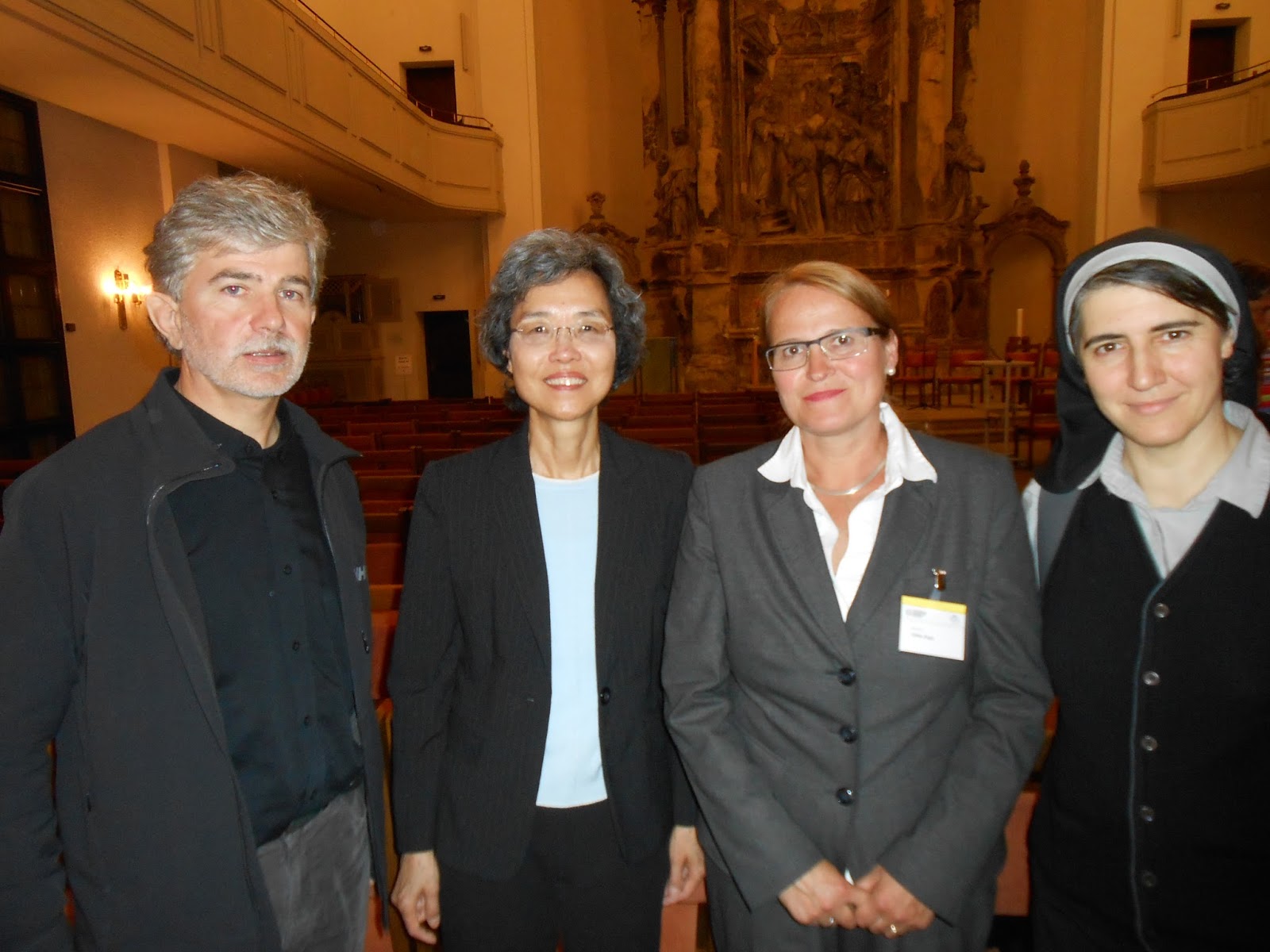
Joerg Rieger, Kwok Pui Lan, Ulrike Auga
from Germany and Teresa Forcades i Vila from Spain
Joerg Rieger and I spoke on “Occupy Heaven: Are God, Religion, and Politics beyond Rescue?” at a public forum during the conference. We were asked to speak about the Occupy Movement and the theological issues it had raised, based on our book Occupy Religion: Theology of the Multitude.

This was the third time that I have attended a conference of the Society and I noticed several important changes. Spanish has become an official language of the Society, together with German and English. About 20 women from Spain attended the conference and their participation was significant. A sizeable group came from Eastern European countries, including Croatia, Lithuania, Poland, Romania, Czech Republic, and Hungary.

In the past, women in Western Europe dominated in the meeting. The leaders of the Society have worked hard to include women from Southern and Eastern Europe. Younger researchers and graduate students were also given space to present their research.

The conference had three sub-themes: postcolonialism, post-secularism, and queer visions. I was glad to see that postcolonial and queer issues have been taken up seriously in the discussion, which I have not seen so much in previous meetings. Musa Dube from Botswana was invited to speak about postcolonial feminist interpretation of the Bible, while Mayra Rivera Rivera from Harvard Divinity School spoke about the key challenges for theologies of the body in the twenty-first century. Janet Jakobsen from Columbia University used the example of domestic work to illustrate the intersection of race, class, gender, and sexuality in thinking about new economies and solidarities.

Dresden was heavily bombed in WWII.
The Church of Our Lady was rebuilt and reopened in 2005
In addition to the plenaries, there were many panels. Two papers were of particular interest to me. Aurica Nutt of Germany presented a paper on queer ecologies and Christian theologies. Drawing from queer ecologies, she discussed why Christian theologies must analyze their discrimination against “unnatural behavior” and against the environment. An interesting point is how queer animals challenge us to think about “nature” and “queerness” differently.

Niki Papageorgiou and Angeliki Ziaka from Greece presented a paper on “Postcolonial Feminist Theological Discourse: Muslim and Christian Interactions.” They talked about the important work done by Islamic feminists on reinterpretation of Qur’an and Shari’a and why feminist theology and reinterpretation of religion could contribute to postcolonial political discourse. They also identified the similarities and differences of Muslim and Christian feminist movements.

European women in theological research face many difficulties and challenges. Jobs are scarce and many with doctorates cannot find teaching positions and have to work in churches and organizations. There seems to be a serious “backlash” or re-traditionalizing of religious traditions. Feminist theologians are increasingly under more pressure. During the conference, participants identified strategies and ways to support one another.

One of the goals I had in going to Dresden was to learn more about changes of women’s lives in Eastern Europe. I bought two books to help me understand the transformation after 1989. Gendering Post-Socialist Transition examines the effects of social and political changes on relationships between women and men, gender roles and representations, and normative discourses about femininity and masculinity in eleven countries in Central- and South Eastern Europe.

Gender and Religion in Central and Eastern Europe contributes to our understanding of theoretical and empirical approaches to the study of gender and religion in post-communist societies. In the United States, we do not have many opportunities learning from women in post-socialist countries. I hope to learn more about the transformation of women’s lives in Central and Eastern Europe in the future. 
 

Monday, June 27, 2011

Hope Abundant Received an Award


About two and a half years ago I met Susan Perry of Orbis Books at the annual meeting of the American Academy of Religion. I told Sue that the book With Passion and Compassion: Third World Women Doing Theology, one of the first anthologies on Third World women’s theology, was out of date. Since the book’s publication by Orbis Books in 1988, the world has changed so much.

Sue said that she had thought of bringing out a sequel. Unfortunately the original editors Virginia Fabella and Mercy Amba Oduyoye were not able to do so.

I told Sue that I have been teaching a course on Third World feminist theology regularly, and we needed a newer text. Sue asked me if I would be willing to bring out a new volume. I was happy to edit a volume to showcase the works of a newer generation of women theologians from Africa, Asia, Latin America, and Oceania.

I also wanted to include indigenous women’s voices, since their contributions to the global chorus of feminist theology have often been neglected.

With Passion and Compassion was based on the first intercontinental conference of the women theologians of the Third World in the city of Oaxtepec, Mexico, in 1986. I was away in the United States doing graduate studies and did not attend the meeting. María Pilar Aquino was kind enough to send me some of the photos she took at the meeting, while I was working on Hope Abundant: Third World and Indigenous Women's Theology. Pilar, Mercy, Virginia, and the other participants looked much younger then.

Third World and indigenous women theologians have published a lot since their initial meeting in Mexico. Mercy Amba Oduyoye was instrumental in forming the Circle of Concerned African Women Theologians in 1989. The Circle became the primary forum for African women theologians to exchange ideas. One of the aims of the Circle was to encourage the publication of theological works by African women.

In 1988, the Asian Women’s Resource Centre for Culture and Theology was formed in Hong Kong. The late Rev. Sun Ai Lee Park from South Korea played a leadership role in the early years of the Centre. The Centre published the journal In God’s Image and many other books on Asian women’s theology. It is now located in Yogyakarta, Indonesia.

The Con-spirando Collective in Santiago, Chile, formed in 1991, provided an avenue for Latin American women to work together and they have devoted their energy to ecofeminist issues. The Collective published a journal Con-spirando.

During my travels in Asia and in the ecumenical circles, I have gathered a lot of materials from Third World women. It was more demanding to find materials from Latin America since the works needed to have been translated. I was fortunate to be able to rely on colleagues such as María Pilar Aquino and Nancy Bedford for suggestions.

I gathered indigenous and tribal women’s theology from India, Philippines, New Zealand, Australia, Palestine, and the United States, though not all pieces went into the book because of limited space. I hope that more work from indigenous women will be available in the future.

Earlier today I was so happy to receive the news that Hope Abundant was awarded second place in the category of Gender Issues by the Catholic Press Association. These awards are presented each year at the Association’s annual convention.

The citation reads: “This is an important book that gathers a new generation of women theologians from Africa, Asia, Oceania, and Latin America into the global theological conversation. Filled with powerful, moving insights from both Protestant and Catholic perspectives, the eighteen contributors explore everything from why the exodus story is a story of liberation for some and a story that justifies occupation and genocide for others to how Catholic women in the Philippines are using women’s mystical tradition and new liturgies and symbols to sustain their work for justice. These are faith-filled theological reflections that offer abundant hope in the midst of poverty, violence, oppression, and war.”

I am very grateful for the recognition and I hope that the award will bring wider publicity for the volume. Proceeds from the book will be used to support the Institute of Women in Religion and Culture at Trinity Theological College in Accra, Ghana, founded by Mercy for training African women leaders. I urge you to support their work by buying a copy of this very exciting volume and please visit the Web site for the book at http://HopeAbundant.org.

Friday, June 3, 2011

Mentors in My Life

When I told people that I had a woman priest in my teenage years in Hong Kong, they were very surprised. That was back in the 1960s!

Deacon Hwang Hsien-yuin was the vicar of my church even before she became one of two women officially ordained in the Anglican Communion in November 1971. Rev. Hwang was an educator and a priest, and she was the principal of a primary school, while serving as the head of my church. Born into a privileged family, Deacon Hwang received her college education in China and obtained a Master’s degree at Columbia University. This was rare for women of her generation.

I was a youth leader of my church and sang in the choir for our 8 a.m. morning service. After the service and before choir practice, Deacon Hwang would come to lead a short devotion. It was during these short devotions that I first heard a feminist interpretation of the Bible. As she struggled to be ordained as a woman priest, she discussed with us the meaning of ministry and God’s calling to both women and men to serve.

I had a desire to know more about Christian faith while serving in the church. I fondly remember it was Dr. Philip Shen’s three lectures on theology that opened my eyes to the breadth and depth of the Christian tradition. Dr. Shen was a professor in the Department of Religion and Philosophy at the Chinese University of Hong Kong. He taught courses on Christian classics and philosophy of religion, and was a keen promoter of general education in higher education. In addition, he was a well-known creator of origami.

As a graduate of the Divinity School at the University of Chicago, he had received a broad-based theological training. When I left Hong Kong to begin my doctoral studies at Harvard Divinity School, Dr. Shen told me not to hurry back and to take my time. He knew more than I did at the time that education of a person is a very long process.

I had the fortune of meeting Professor Letty Russell in Korea the year before I went to the United States for doctoral work. She was invited to deliver a series of lectures on feminist theology in Seoul and I was invited as her respondent. Letty became a mentor, colleague, and friend. Letty, Katie Geneva Cannon, Ada María Isasi-Díaz, and I co-edited the volume Inheriting Our Mothers’ Gardens.

Letty was a keenest supporter and promoter of generations of Third World and racial and ethnic minority women theologians. Many scholars can recount stories of how Letty has helped them in their personal and professional journeys.

It was at Letty and her partner Shannon Clarkson’s home that a small gathering of Asian and Asian American women in theology and ministry was held in the fall of 1984. Letty and Shannon called together several Asian women students studying theology on the East coast and ministers. The network that later became Pacific, Asian, and North American Asian Women in Theology and Ministry (PANAAWTM) was born.

For 12 years, Letty and Shannon served as the network’s advisors, raising and managing funds for us. In 1997 when the Asian and Asian American advisors took over the responsibilities, we had a farewell party for them. I told Letty that it was from her that I learned how to become a mentor, modeling after her example.

During my graduate studies, I had the privilege of studying with Professors Mary Daly and Elisabeth Schüssler Fiorenza. I took a course with Mary Daly soon after her book Pure Lust was published and she used the book as a primary text. The class was small and Daly was famous for “not allowing” men in her classes. From her I learned that women had to learn to think independently outside the “sacred canopy”—the male church hierarchy, androcentric regimes of knowledge, and the male reward system.

Daly’s image of life “on the boundary” became a constant reminder of never submitting to the temptation of “fitting in.” Later when I became interested in postcolonial studies, Daly’s teaching has prepared me to think in the “in-between” spaces. Although I have criticized Daly’s work, my respect for her as a pioneer, trail-blazer, and a fierce fighter for truth is enormous. She also taught me that scholarship can be done with a lot of passion and humor.

Elisabeth was teaching at the Episcopal Divinity School when I took her course on Gospel Stories of Women. Her book In Memory of Her was published a few years ago and quickly became a must-read for women in divinity schools. As women were fighting against male systems of knowing and scholarship, some had misgivings about Elisabeth’s book as it is so dense and with so many footnotes. When I discussed this with Elisabeth, she said that she had worries about who would read her book. The male establishment would not take it seriously and the women would find it too hard. But she said, liberating scholarship is liberating. Women have not been encouraged to develop ourselves to be scholars, and we have to claim back the power to become theological subjects.

I went to Elisabeth’s office for my first appointment with her. She listened to the theological project I was interested in pursuing. Some 25 years after, I still remember the advice she has given me. She told me my work would need three paradigm shifts: from male to female, from West to Asia, and from privileged women to poor women. I did not fully anticipate the process of decolonizing of mind that these paradigm shifts would require and that this would be a life-long work.

I am a faculty member of the Asian Theological Summer Institute, held this week at the Lutheran Theological Seminary in Philadelphia. This Institute provides mentoring and support for Asian and Asian American doctoral students in the United States and Canada. Yesterday during a seminar, I heard myself telling the students that they had to go through multiple paradigm shifts in their work. And I remember I first heard this from Elisabeth.

Learning takes place in a matrix of relationships, as my former student Alan Hesse has said. I am very privileged and fortunate to have many mentors who have accompanied me in my long journey to become a scholar. I came from a family of modest means and my parents were farmers from China. Without the help of others who have recognized that I might have something to contribute, I would never have been able to dream of who and what I can become. I am full of gratitude to my mentors and teachers and I hope to pass on the wisdom I have learned to others.